Yangyang

The next destination after Hwacheon is Yangyang country washed by the East Sea.

Yangyang is not a big country too, having a population of over 27,000 people.

The area was called Yangyang 襄陽 since 1416. The area has a long history since it was known to be a part of Ye-guk 濊國 (3rd-century BC to around early 5th-century). Later it has become a part of Goguryeo and the area of Yangyang was called Ikhyeonhyeon 翼峴縣 or Imunhyeon 伊文縣. It is surprising for me, but both variants are quite nice (if compare to what I have seen before, Hwacheon, Boseong), the literal meaning is Wing Hill or That Culture (it is too complicated to find a proper translation for this pair of characters as the second character have too many meanings). Later, the name of the area was changed several times. In 1222, after a successful defend from Mongolians, it was renamed to Yangju 襄州, where the first character yang means a defender. Later the name was changed again until it has got its present name, consisting of the same yang 襄 and yang 陽, one of the meanings is the sun.

The way to the sea lies through many spots with beautiful scenes. Views from Hangyeryeong.

Even it is just a small observatory with a few buildings, there are many special souvenirs and amazing views to have some meal.

Step by step I am coming closer to ….

Naksan! Naksan is used to designate a few spots in the area, the first one I am going to visit is Naksan Beach.

I was swimming there a lot, that is why I did not take many photos. It is quite an awkward feeling to swim in a sea in Korea, because the swimming area is limited, and I could say it is much narrower than that one could be found in Odesa, Ukraine, moreover, there are so many active lifesavers, what makes the swimming quite tense, all the time I have to check if anybody of them is not running to catch me. I still remember the sea bottom there, it was shallow on the right and unexpectedly deep (for South Korea) on the left, about 2 m deep.

The other place called Naksan is a temple. Naksansa 洛山寺 was built in 671 by a scholar-monk Uisang 義湘 (625–702) who was a close friend of the man I met before in Soyosan and Namhae, it is Wonhyo. The temple is named after Potalaka mount as an abbreviation of the Chinese transcription of from Sanskrit, 補怛洛迦山. By the way, Bomunsa Temple I visited before in Ganghwa before stands on Nakgasan Mountain 洛迦山 which also is named after Potalaka mountain. The legend of the temple foundation explains the reason this name was chosen for the temple.

One of the legends says, when Uisang returned from the Tang empire, he heard that Guanyin Bodhisattva lived in the cave at the east coast of Naksan. He went there to pray and after 7 days praying he has received crystal beads from magic general Sinjang 神將, after 7 more days a dragon from the sea appeared and gave Uisang cintamani (wish-fulfilling jewel), after 7 more days Guanyin Bodhisattva appeared and said, “at the place you sit, a pair of bamboo will spring up, build a temple there”. As it is believed Guanyin or Avalokitesvara Bodhisattva lived in Potalaka mount, this place was called after the mount.

The temple has lived over many events during almost 1400 years. The last notable event happened in 2005 when the temple was burnt due to fire that started in the surrounding forest. The charred remains of the temple recall that day.

In 1925 Uisangdae Pavilion was built on the spot where Uisang once meditated.

Buddhist statue of Haesugwaneumsang. It was built in 1977. The height of the statue is 15 meters, the pedestal is 2.8 meters high.

And a beautiful sunset. Like a painting.

An interesting path to walk for leaving the temple.

My trip around Yangyang is coming to the end, but there is one more very important thing to do…

To eat unlimited sushi!

The huge crabs in the weak lights I saw on the way home reminded me of a horror movie.

That is all about my travelling around South Korea, tomorrow I have a flight back to Ukraine!

Gwangju

The previous day I have visited some places in the southern coast, and the city, I am going to start my trip today with, lays on the south too. It is Gwangju city.

Gwangju is a metropolitan city, with a population of almost 1,5 million people it is the 6th biggest city in South Korea.

The area of the modern city originally belonged to Mahan confederacy, later it was one of the administrative centres of Baekje during three Kingdoms period and was called Noji 奴只, later, during Unified Silla it was called Mujin 武珍. The current name Gwangju 光州 was given to the city during the Goryeo Dynasty.

Here I would emphasize some similarities with the former name of Boseong it had during Baekje, Bokhol 伏忽 which, as for me, is quite humiliating, and the name Gwangju had during Beakje, Noji 奴只, where no 奴 generally means slave. And, same as it happened in Boseong history during the rule of the Unified Silla, the name of the area was changed to positive one, Mujin 武珍, the possible interpretation of this word is a military jewel. However, some theories are suggesting this word should not be understood directly. The character jin 珍 was used to designate stone, which in Korean is pronounced as dol, but, is it supposed that the original pronunciation of dol was duel, and mu is supposed to be pronounced as a close one mul. And, it is supposed that mul means water 水 and duel means field 野. Then, Mujin original pronunciation could be Mulduel, meaning watery fields. This theory is supported by the fact that some of the geographic objects of the city area have pronunciation resembling the word Muduel, such as Mudeung mountain 無等; an area in Yeongsanpo, Naju city is called Idulo 水入伊, Korean pronunciation of each character is mudeul-i, which is supposed to be called so because it is assumed there was a swamp in the area in the past. This disambiguation in the suggested meaning of the word and literal meaning of the word is explained by fact before Chinese characters were introduced into Korean culture, the cities and areas already had its names***. One can notice that it is unlikely to find a Chinese character which would satisfy 2 requirements, to bear the original meaning and to have pronunciation close to the Korean one. In this case, the name might be written using any characters with the pronunciation similar to Korean one, people, who do not know how to write would not care about letters, but they would be very disturbed if one forces them to speak in another way. Other examples of this phenomena are Bisabeol 比斯伐 (Jeonju), Michuhol 彌鄒忽 (Incheon), Dalgubeol 達邱伐 (Daegu), etc.

Street views.

A notable thing about Gwangju city is demonstrations. The last one, Gwangju Uprising, happened in May 1980. A peaceful demonstration against Chun Doo-hwan, the general who served as president from 1980 to 1988, was suppressed by military forces and ended up with 165 (or 1,000-2,000) civils and 37 militaries dead, 76 people were missing and over 3,700 people were injured. Only in 1995, Chun was arrested, in 1996 he was sentenced to death, but in 1997 the sentence was changed to life imprisonment and a fine in the amount of ₩220 billion. Today he is still alive, 88 years old.

Another conflict, raised in 1929, had more crucial consequences for all the country. Gwangju Student Independence Movement is considered to be the second-most important independence movement in the period of the Japanese occupation.

In 1967, Gwangju Student Independence Movement Memorial Hall was opened to commemorate the noble spirits of Student Independence Movement. In 2005, the memorial was relocated.

Student Independence Movement Memorial Tower.

Everything has started from a small incident on October 30, 1929. Japanese students in the train station in Naju harassed a few Korean female students. This incident was the initial cause of anti-Japanese demonstrations in various high schools in Gwangju. Later, it has developed into a nationwide anti-Japanese movement and lasted about 5 months.

The protests resulted in the severe repression from the Japanese government, but those efforts students made not only encouraged national independence movement but also became the predecessor of student movements, the spirit of the student movements inspired the secret society movement, resistance movement, the second student independence movement in May 1943, etc.

That is all about Gwangju, but it is not the end of trip for today!

Jangheung

The last destination this day after Suncheon and Boseong is Jangheung country!

Jangheung county has a population of 38,628 people by November 2019. Since 2001 the population of the country have decreased by 27% (from 53,392).

During Mahan, probably, the area was called Geonmaguk 乾馬國. It is known, that during Baekje, there were several prefectures in the area, namely, Ocha-hyeon 烏次縣, Masanyang-hyeon 馬斯良縣, Komamiji-hyeon 古馬彌知縣, Gyecheon-hyeon 季川縣. Later, during Goryeo, the area raised to the status of a city and was renamed to Jangheungbu 長興府, as it was the hometown of Queen Gongye.

The word jang 長 generally means long, but it also can be understood as long-lasting, profound, permanent, the word heung 興 means rise, thrive, prosper, flourish, etc. Then, 長興 could be permanent prosperity.

I have visited 3 spots in Suncheon, 2 spots in Boseong, so, I have time only for one spot in Jangheung. I am going to visit the Water Festival held on the banks of Tamjin river. The festival is celebrated every year from the end of July to the beginning of August.

The festival really impressed me, because, I think, it was the first time I have seen so many Koreans being excited, free, dancing and just enjoying the time. One more special thing is that the people I saw there have quite a different look, the style of their clothes and quite uncommon (as I thought) behaviour for Koreans (I have seen one madam getting slightly naked when danced). Unfortunately I did not have time to really enjoy the festival, I believe, to do that, one needs to spend at least a day there, from morning until the evening and try all the activities presented there, watch a performance, taste street foods, check up a market, enjoy concert, sing, dance and play with water.

The setting sun, clouds and the fountains made a fantastic scape that day.

Here are some videos from the concert. The woman sings “아이 좋아라” – “Ah, I like it”, that is what I can say about the festival, I like it so much!

And here is the most delicious thing in travelling, the food. Supper is the best way to finish up a day of intense exploring.

Namhae

The next destination after Sacheon is a neighbouring Namhae country.

Namhae country lays on two big islands, Namhae and Changseon, three smaller islands, as I think, having quite funny names, Jodo, Hodo, Nodo, and 65 (76) other uninhabited islets. Namhae Island is the 5th biggest island in South Korea with an area of 301 sq. km., right next after the Ganghwa island (302.5 sq. km), which I visited before. The total population of the country is about 44,642 people.

The Bronze Age dolmens found on the island evidence the people lived here as early, as at inland. The first records about the country appear in 690, during Silla, when the area was named as Jeonyasan-gun 轉也山郡. In 757, it was renamed to Namhae-gun. The name Namhae consists of two quite popular and meaningful characters, nam 南 – south and hae 海 – sea. As a consequence, there are a few geographic objects in the Far East region called 南海. Among them, 南海 – a sea near North Korea, 南海 – the Chinese name of the South China Sea, 南海道 – a region in Japan and so on.

A quick review:

  • Changseon 昌善島, chang 昌 – prosperous, beautiful, bright; seon 善, same as in Jeongseon country 旌善郡, good, beautiful, good, kind, excellent, best; kindhearted, hospitable, friendly; auspicious, happy, 島 – island;
  • Jodo 鳥島, jo 鳥 – bird; 鳥 in Chinese usually is pronounced as niao; diao and dao are other possible pronunciations; in the cases when the character designates a geographic place, it is pronounced as que, resembling that of Korean, jo;
  • Hodo 虎島, ho 虎 – tiger;
  • Nodo 櫓島, no 櫓 – castle, scull, big shield.

One of the notable spots in the Namhae country is the German village Dogil Maeul.

In 1997, Du-Kwan Kim, the mayor of Namhae-gun, visited Nordfriesland, a city in Germany, where he met Korean migrants, who went to work to Germany in the 60s. The migrants shared with the major a wish to return back to their home country at retirement age. This wish, along with the fact the population of Namhae country was decreasing since 1965 due to the migration of people to the industrial areas, gave the beginning to the village foundation in 2000.

The district acquired almost 100,000 sq. m. of land to build houses which should look as “German”. This also would be an attraction for tourists. In July 2012, the village had 39 German-looking houses.

A view from a roadside.

Because Namhae is an island, one thing I must to do here is to swim! The island is washed by waters of the Korea Strait, which connects three seas, the Yellow Sea, the East China Sea and the East Sea (the Sea of Japan). Consequently, I would expect the water here to be better than in the Yellow Sea, but not as good as in the East Sea.

I think it is that girl with her mother that I gave the shellfishes I collected. The girl did not dare to take my shells, even though she was looking for them, I just threw it in her bucket after the parents made me understand it is ok, they requested her to say “thank you”, but seems she was really shy seeing a hairy stranger. The whole bottom is full of these shells, one just needs to know how to find it, so, I do. The shells won’t float in the water waiting for you to catch them, you need to get into the sand to grab it. I will not die if I live in a wild in South Korea.

Since visiting the Museum of Natural History, I am always looking for fossils, such as dinosaur eggs or dinosaur excrements, just like those.

One of the attractions on the island is Guemsan mountain. With a height of 681 m, it is the second biggest mountain on the island, the first one is Mangunsan, 786m. There is a country with exactly same name Geumsan, 錦山, bordering on the south with Muju and Jinan countries I visited before. The character geum 錦 means beautiful, luxurious, refined or brocade; bearing such a positive sense, no surprise it is used in geographic names.

That day the mountain was shrouded with fog, so, it was hard to see the environment.

On the hills of the mountain, there is Boriam hermitage 菩提庵. Bori 菩提 is a Buddhist term, meaning perfect comprehension, insight, consciousness, and am 庵 means hermitage; Boriam – the hermitage of perfect comprehension. The temple was founded in 686 by Wonhyo, a priest and commentator of the Korean Buddhist tradition. I met this man before when studied the history of Soyosan mountain, Jajaeam temple also was founded by Wonhyo. It seems that the circumstances do not let me see the creations of Wonhyo, as the first time I was too tired to do that, and now, the fog hid the hermitage.

Many stones with words carved on it are lying on the hermitage territory.

The patterns on some stones draw unusual pictures in my imagination, the reddish blot looks like a dinosaur head, and the roundish stone looks like a big tooth.

This is the comparison of that what could I see and that what do I see.

Dinner is the best way to finish the active trip around Namhae country!

Sacheon

This time I am going to the southern part of South Korea, South Gyeongsang Province. the first destination here is Ocean Cable Car in Sacheon city.

Sacheon 泗川 city with a population of 117,207 people, takes 67th place on the list of the biggest cities in South Korea, right after Gongju, the city I have visited before.

The city name Sacheon 泗川 resembles the name of a quite famous Chinese province Sichaun 四川, however, it is not the same. The former name of the city, established by Silla, is Samul 史勿, which means no history. In 757 the city was renamed into the homonymous Samul 泗水, which gave the origin to the modern name Sacheon 泗川.

In modern Chinese, the character 泗 is used to designate nasal mucus, however, this character also is used as a hydronym or a toponym, for example, a river in Shangdong province, China, Sishui 泗水, which got this name because the river begins with 4 springs, so 水 + 四 = 泗. Then, the city name Sachen simply means river Sa.

The place I am going to visit in Sacheon is Ocean Cable Car. First, the cabin goes above a bay to a small island, makes a circle and then goes up to a mountain. The strong wind accelerates on the wide free space above the bay, enters the cabin through the gaps and howls, making the environment more dramatic. After a few minutes, the cars and people became toys on the game table.

Gaksan mountain 角山, probably means Cape Mountain (compare, Cape Town), 408 m. One can almost touch the sky here.

There is a beacon signal station on the top of the mountain. In Korea, first beacon signalling systems became to be used in the Three Kingdom period (1st BCE – 7th AD). This station was built in the Goryeo period (918-1392) and was in use until 1895.

It is time to come back to the ground and move on!

National Museum of Korea

Last year I have already visited this museum, but it is huge, so, I didn’t have enough time to see exhibitions on the third floor. This year I am coming again, to complete exploring the museum.

The exhibitions of the museum are dedicated to the history and art of Korea. There are 310,000 pieces in its collection with about 15,000 pieces on display at one time. It is the sixth-largest museum in the world in terms of floor space, covering a total of 295,551 sq. m. Also, it is one of the most visited museums in the world, with 3,300,000 visitors in 2018; the first place takes Louvre with 10,200,000 visitors.

On the third floor, there are two permanent exhibitions, “Asian Arts” and “Sculpture and Crafts”. The museum has an exemplary website providing detailed information about the exhibitions, collection database, and so on.

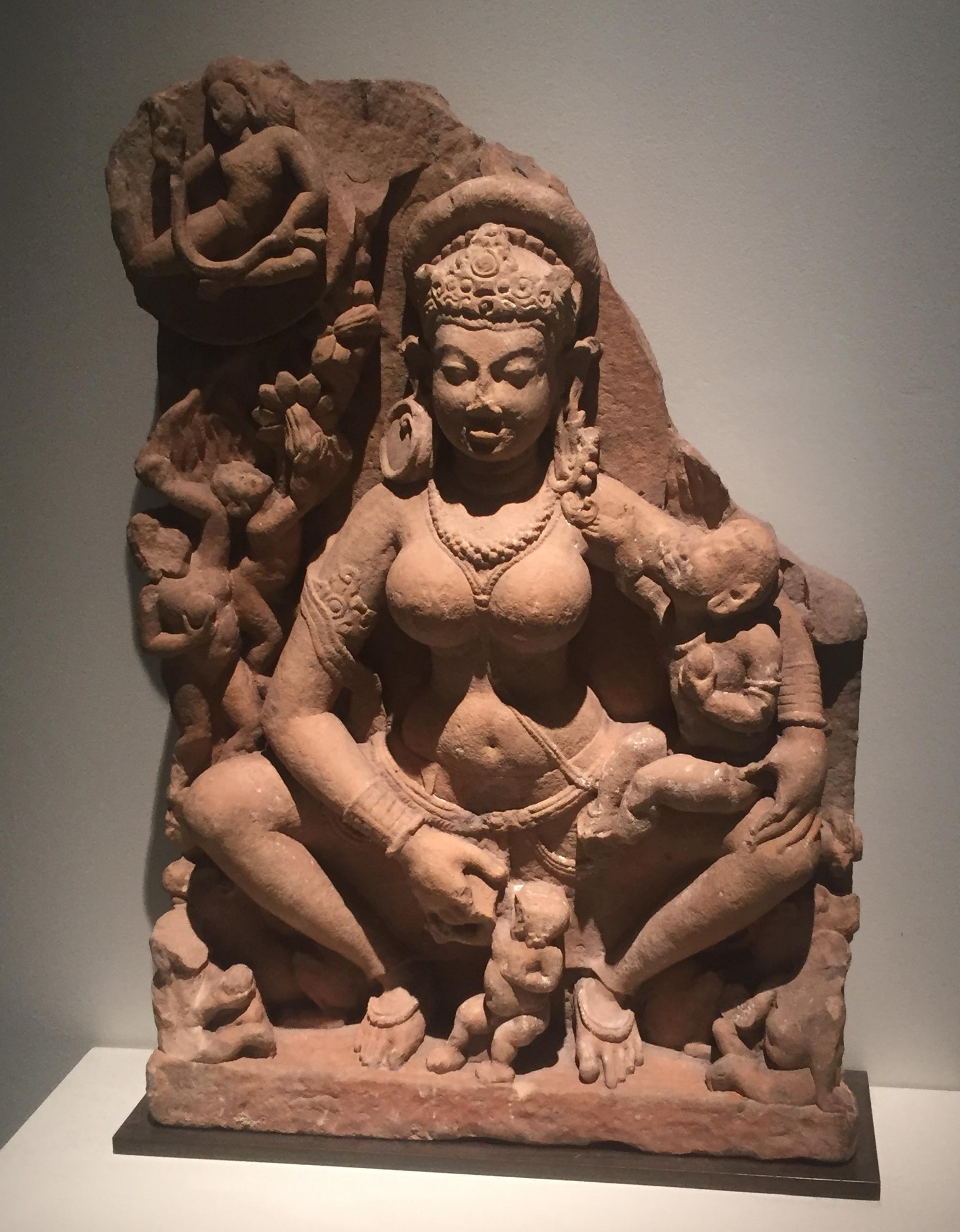
The “Asian Arts” consists of 5 sections. The first one is “India and Southeast Asia Gallery”.

The notable part of Indian culture is Hinduism and Buddhism, so, no wonder, many of sculptures represent the gods:

  • Vishnu, one of three major gods in Hinduism; God of Protection, Preservation of Good, Controller of entire Universe, Karma restoration, Moksha (various forms of emancipation, enlightenment, liberation, and release)
  • Parvati, or Mother Goddess, the Hindu goddess of fertility, love, beauty, marriage, children, and devotion; as well as of divine strength and power.
  • Bodhisattva, in Buddhism, any person who is on the path towards Buddhahood.

The next part is “Central Asia Gallery”. The items presented here were mostly excavated from Xinjiang, China.

The exhibited items were mostly excavated from Xinjiang, China, including Astana Cemetery (4th-8th century) near Turpan. The objects of the Astana tombs came to the museum from Japan, during the annexation of 1910, where they had been brought from expeditions of Ōtani Kōzui in 1905.

Fuxi 伏羲 and his sister, Nuwa 女媧, are the mythological creators of mankind. They have snake-like tails and humanlike upper part of the body. The myth of mankind creation varies depending on the source since during the thousands of years numerous Chinese nations retold and developed the myth in their specific way.

The legend fro Tianshui City, Gansu Province. There was only one old woman in ancient times. One day, she saw a big footprint and stepped on it. Unexpectedly, she has got pregnant. The old woman gave birth to a boy and a girl. After the death of the old woman, the children lived by themselves, hunted, grew up. One day it has become the time to discuss a thing of two (man and woman thing). They decided to verify the possibility of their marriage using millstones. They let the millstones rolldown from Wutai mountain. The result was the millstones matched each other, which meant they can marry. After the marriage, mankind was pullulating.

In other variants, Fuxi and Nuwa used fire smoke from two separate sources to verify the marriage; or, used clay to create people.

The next galleries are “China Gallery” and “Sinan Shipwreck Collection Gallery”.

The last part of the “Asian Arts” is “Japan Gallery”.

The other exhibition on the third floor is “Sculpture and Crafts”, consisting of 5 galleries.

“White Porcelain Gallery”. The “proto-porcelain” was invented in Shang dynasty (1600–1046 BC). By the late Sui dynasty (581–618 AD) and early Tang dynasty (618–907 AD), the now-standard requirements of whiteness and translucency had been achieved. By the time of the Ming dynasty (1368–1644 AD), porcelain wares were being exported to Europe.

Korean porcelain was first produced in the late 9th or early 10th century. The early period of the production of the white porcelain begins in 1467-1468 when royal ware was first produced at the kilns in Gwangju (a place I am going to visit later). The white porcelain is the representative pottery of the Joseon Dynasty (1392–1897) in Korea.

“Buncheong Ware Gallery”. Buncheong ware (粉靑沙器) originated as low quality inlaid celadon produced in the late Goryeo Dynasty, but in the early Joseon Dynasty, it evolved into an entirely new type of pottery with unique aesthetic features. Buncheong ware is made by coating the surface of celadon with white mud. There are seven major methods to create the patterns (inlaying, stamping, incising, reverse inlaying or sgraffito, painting, brushing, dipping).

“Celadon Gallery”. Celadon is a type of green glaze or a ware glazed with celadon. Under the influence of China’s Yue ware, in the 9th-10th century, along with white porcelain, Koreans began producing celadon too. Later, the war with the Yuan Dynasty (1271–1368) and the Japanese invasions (late 14th century) indirectly caused the gradual decreasing of the celadon quality, which ended up with the emerge of the Buncheong ware.

“Metal Crafts Gallery”.

  • Vajra is is a weapon used as a ritual object to symbolize both the properties of a diamond (indestructibility) and a thunderbolt (irresistible force). It is used symbolically by the dharma traditions of Buddhism, Jainism and Hinduism.

“Buddhist Sculpture Gallery”. When travelling around South Korea I have seen many Buddhist temples, so, it is obvious that Buddhism played an important role for hundreds of years in the history of Korea, no surprise there is a special section dedicated to Buddhist sculptures. Since the museum also is an educational centre, I discovered here quite interesting information about the appearance of Buddha in different countries and types of Buddha’s poses.

A bodhisattva is a being who is dedicated to achieving complete Buddhahood (the condition or rank of a buddha “awakened one”). There are different classifications of the bodhisattva, containing from a couple up to hundreds of bodhisattva. However, 8 primary bodhistavas are distinguished, among them, Avalokiteśvara, a bodhisattva who embodies the compassion of all Buddhas. Previously I have seen Avalokiteśvara in Geumdangsa temple, Maisan.

  • Bhaiṣajyaguru – the Buddha of healing and medicine.
  • Amitābha – a celestial buddha.

Views around the museum.

That is all about the National Museum of Korea. I strongly recommend to visit it because the museum exhibits a great collection of the artefacts covering various topics, it provides rich information about the history and the culture, and, moreover, the entrance is free of charge.

And, of course, such an inspiring visiting should be followed by a delicious supper!