My last trip around South Korea in 2019 starts with Hwacheon country.
Hwacheon is not a big country with a population of about 25,000 people.
During Goguryeo, this area was called Saengcheon-gun 牲川郡 or Yasimae 也尸買. As I found out before, Goguryeo used to give quite negative names to the areas under their rule to show dominance. Saengcheon and Yasimae, as for me, are not exceptions too, because saeng 牲 means a sacrificial animal and si 尸 means a corpse. In 685, during Silla, the region was renamed to more neutral or even positive – Nangcheon 狼川 – Wolf River. Later it was renamed a few times and only in 1869, the area got its present name, Hwacheon 華川 – Flowery River.
The first stop in Hwacheon country is Sanae-myeon where Tomato Festival is held! Would you expect to see there just a fair where plenty of tomato species or tomato products are shown? Then your imagination is the same as weak as mine.
What are they doing? Do they cook ketchup in this way? No, that is how they are looking for a golden ring hidden in one of the tomatoes. I would join them if I have another complect of clothes, but the only thing I could do is just to film and feel envy.
By the way, I tasted some tomatoes there too.
The next destination is Hwacheon Museum. Craft tools, pottery and other items related to Hwacheon history are presented here.
Tiger and magpies is a prominent motif in the minhwa folk art of the Joseon period. The paintings are a satire of the hierarchical structure of Joseon feudal society. The tiger, which is intentionally given a ridiculous and stupid appearance represents authority, while the magpie represents the common man. The painting is known to keep away evil influence.
Seunggyeongdo 陞卿圖 game board. A similar Chinese game takes its origin during Tang dynasty, the earliest historical record dates back to 836. The origin of the Korean game is not known, however, there is a record saying Ha Ryun (1377-1416) made and spread the game. The objective of the game is to attain the highest possible bureaucratic position. Probably the game was used with an educational purpose for candidates on a government post.
Outside the museum there are some items visitors can try, like a basket or traditional games.
The next destination is Oeum-ri, Vietnam Memorial Hall.
During the Vietnam war (1955-1975), from 1964 to March 1973, South Korea sent more than 300,000 troops to South Vietnam, 5099 Koreans were killed. A controversial consequence on the participation in the war is a boost in the South Korean economy due to payments of the US, which are estimated to account for 4% of GDP in 1967.
There are Vietnamese houses of the territory of the memorial.
And small hiding frogs avoiding the sun on an underground stair.
That is all about Hwacheon country, it is time to move on!
Ungjin-ri, somewhere on a bank of Soyangho Lake, the largest man-made lake in South Korea. Soyang Dam is Asia’s largest and the world’s fourth-largest rock-fill dam.
By the way, the name of the village reminds me of Gongju, the city of a legend about a man and a bear. Originally Gongju was called Ungjin 熊津 too, however, I do not know the meaning of the village’s name. It could be the same, Ford of Bear.
Last year I have already visited this museum, but it is huge, so, I didn’t have enough time to see exhibitions on the third floor. This year I am coming again, to complete exploring the museum.
The exhibitions of the museum are dedicated to the history and art of Korea. There are 310,000 pieces in its collection with about 15,000 pieces on display at one time. It is the sixth-largest museum in the world in terms of floor space, covering a total of 295,551 sq. m. Also, it is one of the most visited museums in the world, with 3,300,000 visitors in 2018; the first place takes Louvre with 10,200,000 visitors.
On the third floor, there are two permanent exhibitions, “Asian Arts” and “Sculpture and Crafts”. The museum has an exemplary website providing detailed information about the exhibitions, collection database, and so on.
The “Asian Arts” consists of 5 sections. The first one is “India and Southeast Asia Gallery”.
Vishnu, Pala period 12th-13th century
Parvati, Chola period 13th century
Door jamb
Incence burner, Mac-Le dynasty, Vietnam 16th-17th century
Bronze drum, Dong Son culture, Vietnam BCE 5th – 1st
Bodhisattva
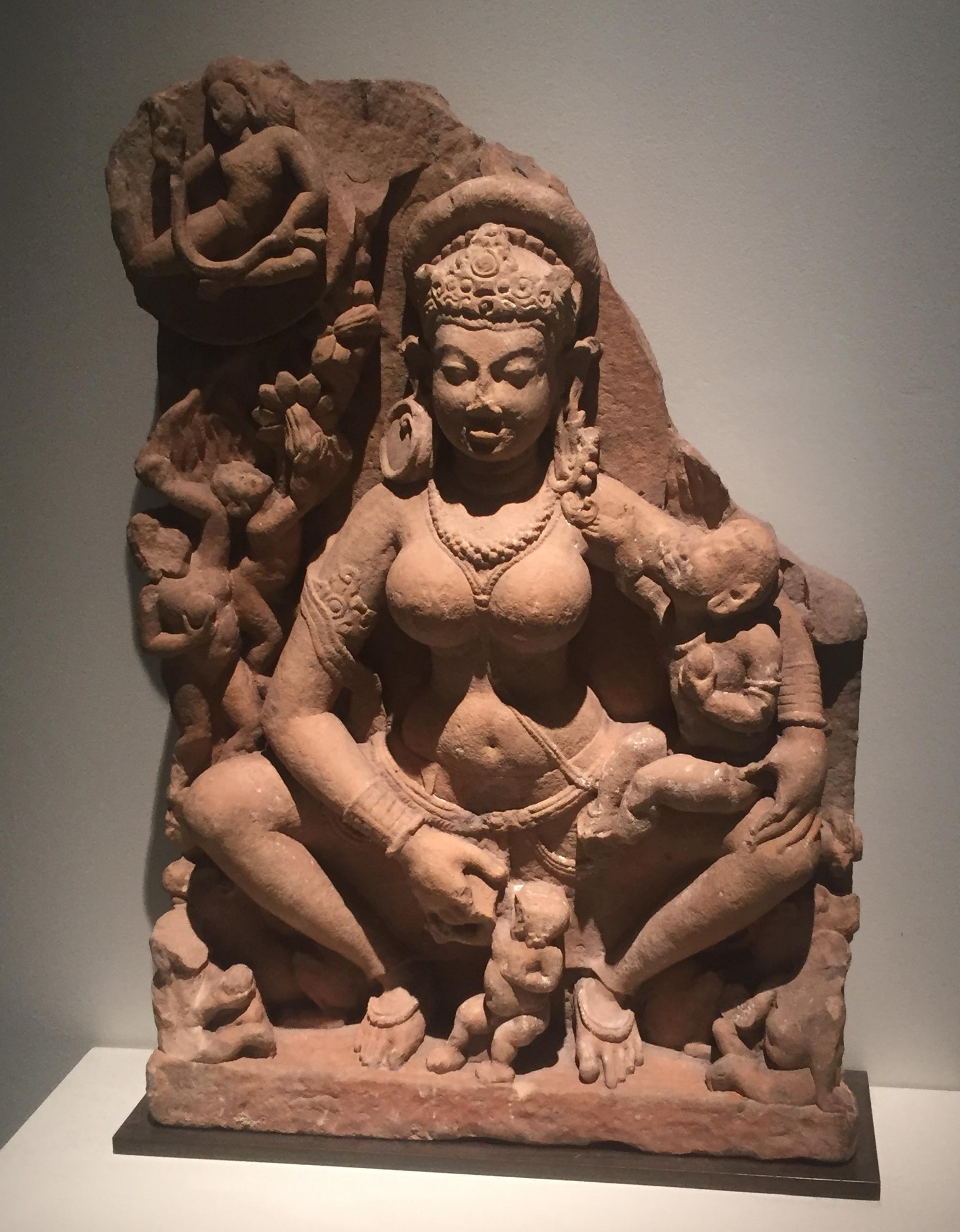
Mother Goddess
The notable part of Indian culture is Hinduism and Buddhism, so, no wonder, many of sculptures represent the gods:
Vishnu, one of three major gods in Hinduism; God of Protection, Preservation of Good, Controller of entire Universe, Karma restoration, Moksha (various forms of emancipation, enlightenment, liberation, and release)
Parvati, or Mother Goddess, the Hindu goddess of fertility, love, beauty, marriage, children, and devotion; as well as of divine strength and power.
Bodhisattva, in Buddhism, any person who is on the path towards Buddhahood.
The next part is “Central Asia Gallery”. The items presented here were mostly excavated from Xinjiang, China.
7th-8th century
Fuxi and Nuwa 7th century
6th-7th century
6th-7th century
The exhibited items were mostly excavated from Xinjiang, China, including Astana Cemetery (4th-8th century) near Turpan. The objects of the Astana tombs came to the museum from Japan, during the annexation of 1910, where they had been brought from expeditions of Ōtani Kōzui in 1905.
Fuxi 伏羲 and his sister, Nuwa 女媧, are the mythological creators of mankind. They have snake-like tails and humanlike upper part of the body. The myth of mankind creation varies depending on the source since during the thousands of years numerous Chinese nations retold and developed the myth in their specific way.
The legend fro Tianshui City, Gansu Province. There was only one old woman in ancient times. One day, she saw a big footprint and stepped on it. Unexpectedly, she has got pregnant. The old woman gave birth to a boy and a girl. After the death of the old woman, the children lived by themselves, hunted, grew up. One day it has become the time to discuss a thing of two (man and woman thing). They decided to verify the possibility of their marriage using millstones. They let the millstones rolldown from Wutai mountain. The result was the millstones matched each other, which meant they can marry. After the marriage, mankind was pullulating.
In other variants, Fuxi and Nuwa used fire smoke from two separate sources to verify the marriage; or, used clay to create people.
The next galleries are “China Gallery” and “Sinan Shipwreck Collection Gallery”.
Bodhisattva Song Dynasty
Pensive Bodhisattva Northern Qi
Northern Song
Celadon Pillow Song Dynasty
Southern Song
Late 13th – early 14th century
The last part of the “Asian Arts” is “Japan Gallery”.
1664-1660s
Noh masks 16th-17th century
Story of the 53 station of the TokaidoRoad: Yokkaichi
The other exhibition on the third floor is “Sculpture and Crafts”, consisting of 5 galleries.
“White Porcelain Gallery”. The “proto-porcelain” was invented in Shang dynasty (1600–1046 BC). By the late Sui dynasty (581–618 AD) and early Tang dynasty (618–907 AD), the now-standard requirements of whiteness and translucency had been achieved. By the time of the Ming dynasty (1368–1644 AD), porcelain wares were being exported to Europe.
Korean porcelain was first produced in the late 9th or early 10th century. The early period of the production of the white porcelain begins in 1467-1468 when royal ware was first produced at the kilns in Gwangju (a place I am going to visit later). The white porcelain is the representative pottery of the Joseon Dynasty (1392–1897) in Korea.
Seoul, 15th-16th century
15th century
“Buncheong Ware Gallery”. Buncheong ware (粉靑沙器) originated as low quality inlaid celadon produced in the late Goryeo Dynasty, but in the early Joseon Dynasty, it evolved into an entirely new type of pottery with unique aesthetic features. Buncheong ware is made by coating the surface of celadon with white mud. There are seven major methods to create the patterns (inlaying, stamping, incising, reverse inlaying or sgraffito, painting, brushing, dipping).
Stamped design and inscription 15th century
Sgraffito 15th-16th century
Incised design 15th-16th century
Sgraffito design 15th century
“Celadon Gallery”. Celadon is a type of green glaze or a ware glazed with celadon. Under the influence of China’s Yue ware, in the 9th-10th century, along with white porcelain, Koreans began producing celadon too. Later, the war with the Yuan Dynasty (1271–1368) and the Japanese invasions (late 14th century) indirectly caused the gradual decreasing of the celadon quality, which ended up with the emerge of the Buncheong ware.
Vajra is is a weapon used as a ritual object to symbolize both the properties of a diamond (indestructibility) and a thunderbolt (irresistible force). It is used symbolically by the dharma traditions of Buddhism, Jainism and Hinduism.
“Buddhist Sculpture Gallery”. When travelling around South Korea I have seen many Buddhist temples, so, it is obvious that Buddhism played an important role for hundreds of years in the history of Korea, no surprise there is a special section dedicated to Buddhist sculptures. Since the museum also is an educational centre, I discovered here quite interesting information about the appearance of Buddha in different countries and types of Buddha’s poses.
Pensive bodhisattva
Golden Buddha and Amitabha Buddha
The oldest Buddhist sculpture with an inscribed date that has ever been found in Korea, circa 539 CE.
Bhaisajyaguru Buddha
Avalokiteshvara Bodhisattva
Avalokitesvara Bodhisattva
A bodhisattva is a being who is dedicated to achieving complete Buddhahood (the condition or rank of a buddha “awakened one”). There are different classifications of the bodhisattva, containing from a couple up to hundreds of bodhisattva. However, 8 primary bodhistavas are distinguished, among them, Avalokiteśvara, a bodhisattva who embodies the compassion of all Buddhas. Previously I have seen Avalokiteśvara in Geumdangsa temple, Maisan.
Bhaiṣajyaguru – the Buddha of healing and medicine.
Amitābha – a celestial buddha.
Goryeo period 10th century
Goryeo period 10th century
Unified Silla 8th-9th century
Goryeo period 10th century
Goryeo dynasty 11th century
Views around the museum.
That is all about the National Museum of Korea. I strongly recommend to visit it because the museum exhibits a great collection of the artefacts covering various topics, it provides rich information about the history and the culture, and, moreover, the entrance is free of charge.
And, of course, such an inspiring visiting should be followed by a delicious supper!




 lezhok