My friend is so lazy because he likes to go to work every day, so, I had to spend that day alone, find an activity.
Museum!
Which one?
Seems I have seen so many of them. Maybe there’re some other great museums left?
It is so good that I have made a screenshot, so now I know the name of the museum – National Folk Museum of Korea.
I wasn’t sure, is it my first time to be there until I entered.
I felt excited this moment, being in Korea again, such a special and exotic place to me.
Even many people told me, that July is the worst time to come here due to the hot and humid weather, I want to be there now, because I am freezing here, in my cold room, and cold outside, only vodka can warm me up.
I always imagine Korea hot, because I have been only during summer, however, winter is cold there too.
Glassy futuristic skyscraper and roads full of colourful sings, contrasting relatively small, wooden-stone ancient buildings along with the buoyant green make up the face of Seoul.
On the way to the museum! I bet it is as hot there as at the hell, I have forgotten that feeling, but I see people on the photo are trying to walk in the shadow; it makes me smile now.
Then, I have entered.
Science: medicine, astronomy, geography, magic and so on.
About agriculture
The first character looks uncertain for me because I didn’t find the exact one or any variety of 農, but I think that means something like: agriculture is the base of the world. It is such a close to the Ukrainian culture phrase. About 70% of the Ukrainian land (603 000 sq km) is the agricultural land (420 000 sq km), which is 4 times more than the whole area of South Korea and even twice more than the whole area of North and South Korea together. Seems unbelievable? However, after visiting Korea I can confidently state that Ukrainians do not really understand the meaning of the phrase above. The huge land is used almost for nothing, not effectively, when you compare to the Korean one. A rain – the crops are destroyed, high temperature – crops are destroyed, wind – crops are destroyed. What I saw in Korea, that each piece of the land is used wisely, even the land seemed to be fruitless along the road is a good place to grow onion, if you know how to do it. Weather is even crazier than in Ukraine: extremely high temperatures, strong wind – nothing can harm, because the crops are protected from the sun and the ground is covered to decrease the evaporation; trees are supported to stand the strong wind. What is a naughty bird wants to eat your fruit? It is a difficult task for the bird – each fruit is covered to be protected. Moreover, a funny thing is that there’s no planning: one year plant too many onions (very cheap), next year nobody plants it (crazily expensive, import).
A cute house for chicks.
There’s a similar tool used in Ukraine to tamp ground, is it used in the same way in Korea? Fishing. A very funny tool, who do you catch with it? Medicine grinder.
My favourite place – I can sleep here. And a nice pillow, what I have seen before in other cultures, it was something solid to support the head, but this one looks pretty comfortable.
Paintings. Feel the culture.
It would be much better if I carefully read the descriptions beneath the items, but I don’t know the special words, so I just enjoyed the appearance and turn on my imagination to guess the story behind each item.
This part of the exhibition made me very upset because I was so hungry at that time, so hungry…
I need more and more foooooooood.
Later in the evening.
Hahahahah.
After the dinner, to keep me fit I participated in Dongducheon sports competition! But still, I don’t know who won…
My last trip around South Korea in 2019 starts with Hwacheon country.
Hwacheon is not a big country with a population of about 25,000 people.
During Goguryeo, this area was called Saengcheon-gun 牲川郡 or Yasimae 也尸買. As I found out before, Goguryeo used to give quite negative names to the areas under their rule to show dominance. Saengcheon and Yasimae, as for me, are not exceptions too, because saeng 牲 means a sacrificial animal and si 尸 means a corpse. In 685, during Silla, the region was renamed to more neutral or even positive – Nangcheon 狼川 – Wolf River. Later it was renamed a few times and only in 1869, the area got its present name, Hwacheon 華川 – Flowery River.
The first stop in Hwacheon country is Sanae-myeon where Tomato Festival is held! Would you expect to see there just a fair where plenty of tomato species or tomato products are shown? Then your imagination is the same as weak as mine.
What are they doing? Do they cook ketchup in this way? No, that is how they are looking for a golden ring hidden in one of the tomatoes. I would join them if I have another complect of clothes, but the only thing I could do is just to film and feel envy.
By the way, I tasted some tomatoes there too.
The next destination is Hwacheon Museum. Craft tools, pottery and other items related to Hwacheon history are presented here.
Tiger and magpies is a prominent motif in the minhwa folk art of the Joseon period. The paintings are a satire of the hierarchical structure of Joseon feudal society. The tiger, which is intentionally given a ridiculous and stupid appearance represents authority, while the magpie represents the common man. The painting is known to keep away evil influence.
Seunggyeongdo 陞卿圖 game board. A similar Chinese game takes its origin during Tang dynasty, the earliest historical record dates back to 836. The origin of the Korean game is not known, however, there is a record saying Ha Ryun (1377-1416) made and spread the game. The objective of the game is to attain the highest possible bureaucratic position. Probably the game was used with an educational purpose for candidates on a government post.
Outside the museum there are some items visitors can try, like a basket or traditional games.
The next destination is Oeum-ri, Vietnam Memorial Hall.
During the Vietnam war (1955-1975), from 1964 to March 1973, South Korea sent more than 300,000 troops to South Vietnam, 5099 Koreans were killed. A controversial consequence on the participation in the war is a boost in the South Korean economy due to payments of the US, which are estimated to account for 4% of GDP in 1967.
There are Vietnamese houses of the territory of the memorial.
And small hiding frogs avoiding the sun on an underground stair.
That is all about Hwacheon country, it is time to move on!
Ungjin-ri, somewhere on a bank of Soyangho Lake, the largest man-made lake in South Korea. Soyang Dam is Asia’s largest and the world’s fourth-largest rock-fill dam.
By the way, the name of the village reminds me of Gongju, the city of a legend about a man and a bear. Originally Gongju was called Ungjin 熊津 too, however, I do not know the meaning of the village’s name. It could be the same, Ford of Bear.
Those days when I was not travelling around South Korea usually I was going to Seoul to have some walks, probably, meet some people, have meals and so on.
My favourite location for hangout was Dongdaemun. The area has several attracting features as Dongdaemun History & Culture Park, Russian town, shopping malls, and, along with the busy city life, there are places to chill out like Dongdaemunseong-gwak Park and long Cheonggyecheon Stream. I was coming here I guess over 10 times, almost every time I was drinking beer on the stream banks.
Dongdaemunseong-gwak park is connected to Naksan park, from where one can view Seoul from the hight, especially rich areas.
A couple of kilometres to the west from Dongdaemun there is an extremely popular among tourists location called Myeongdong. The area is really overcrowded with foreigners the same as with locals too. A special feeling arises when you are among that thousands of people gathering there, however, I would not say there is something extremely special in the area, plenty of restaurants and cafes and varieties of shops. For the reason of popularity, this place was my meeting point for a few times. Sometimes I was sitting on a bench and drinking coffee from a convenience store nearby the Myeongdong catholic Church. It was my first time to visit an animal cafe with dogs.
A short walk to the west from Myeongdong, there is a very city centre of Seoul, City Hall, where I was coming for a couple of times too, like that time I went to visit Deoksugung palace. One day I came there and saw a demonstration, seems dedicated to the enprisoned ex president Park Geun-hye
박근혜를 석방하라!
On the square, there is the Seoul Metropolitan Library. The building is one of the few surviving buildings built during the Japanese occupation.
Another notable place in Dongdaemun district is Gyeongdong market, one of the largest herbal medicine and ginseng markets of South Korea.
One of the most disappointing events was my visiting of the Toilet Museum in Suwon. My expectations were extremely exaggerated maybe due to my amazing experience of visiting Museum of Sex and Health on Jeju island, maybe because this museum was recommended to be visited on Ukrainian tv, but the time I have spent to reach the museum and that what I saw there have disappointed me a lot. As I remember it took for me over three hours in one way, over 2 hours on the subway and up to one hour walking from a metro station to the museum. I was so critical about the museum because by the time I reached it I was exhausted. The museum is free for visitors, but is it quite small, and I expected to see more items, but the museum as I understand is more educational like, probably aiming very young auditory.
One funny thing I saw on the way to the museum was onion growing right on a highway side. After seeing that, I again realized how bad is Ukrainian situation, having so many “fruitful”, as all the politicians say, ground and such expensive, low-quality crops, while it seems all South Korea is covered by mountains, the area is almost 5 times smaller than the area of Ukraine, but Koreans are not starving and are far away from that.
Sometimes I was working hard on a military plant, my task was to build nuclear rockets.
Gwangnaru Park on Han-gang river bank.
Looking for souvenirs near Anguk and Jongno 3-ga metro stations, in the end, I came to Cheonggyecheon stream. These green firs remind me how hot it was there that day.
And sometimes I was somewhere around Dongducheon.
And of course, during my trip, I was eating all the food and drinking all the beer South Korea has…
An interesting thing happened to me in a shop. The vegetables are weighed on the cash desk. So, just pick those cucumbers. But why do you weigh tomatoes? Because tomatoes are fruits.
I tried my best to finish up all the reserves, but I did not succeed. I must try to do it one more time!
After Gwangju city, I am going to discover a few spots in Gochang and Buan countries, North Jeolla province.
It is not my first time coming to North Jeolla province, this year I have also visited the capital city, Jeonju, along with Gunsan city, Jinan and Muju countries.
The first place I am going to visit is Pansori museum in Gochang.
Pansori is a Korean genre of musical storytelling performed by a singer and a drummer. The word Pansori consists of two words, pan, which is supposed to mean a situation where many people are gathered or a song composed of varying tones, and sori, which means sound. The genre is thought to be originated in the late 17th century during the Joseon Dynasty. The earliest performers of pansori were most likely shamans and street performers, and their audiences were lower-class people.
The Gochang Pansori Museum was established in the old residence of ‘Dongni’ Sin Jae-Hyo (a musical theorist and arranger and a sponsor of Pansori) with the aim of honoring the great Pansori singers of the past (including Sin Jae-Hyo) and preserving and developing the indigenous tradition of Pansori***.
Except exhibiting numerous items related to Pamsori like music instruments, vinyl records, fans, the museum provides records of various songs performed by famous singers which can be listened in several ways, via video, from a music box, or in culm with headphones, what makes the acquaintance more adventuring. Also, one can try to play the drum like a real Pansori drummer.
Examples of different styles je 制 of pansori, loud and powerful Dongpyeonje 東便制, smooth and sorrowful Seopyeonje 西便制, and compromising between two those styles, Junggoje 中高制. ***
During the 18th century, 12 song cycles madang were established as the repertoire of pansori stories, but only 5 of them survived until now.
Chunhyangga – the story of love
Heungbuga – the story about a poor but good man with many children
Simcheongga – the story about a daughter and her blind father
Sugungga – an adaptation of “A Tale of Rabbit and Turtle”
Jeokbyeokga – Chinese historical legend of the Battle of Red Cliffs
Mosaics on the museum facade depict scenes from these stories.
One story might last for 10 hours, so, musicians may only perform certain sections, highlighting the most popular parts of a madang.
I will show just some passages of Chunhyangga too:***
… Don’t you know the butterfly must pursue the flower, and the geese must seek the sea?…
…No, I shall not look at you, I shall not listen to you. Cut my body into pieces if you like, but I shall never go to you…
Very dramatic scenario. This story is considered to be the most popular.
And, it is time to leave the museum and move on!
From Gochang country I am moving to the neighbouring Buan country. The first place to visit here is Gomso salt fields.
The first records about salt production in Buan country date back to 1454.
In 2018 South Korea produced 264.6 thousand tonnes of salt (#49 in the world), for comparison, Ukraine produced over 23 times more, 6,279.77 thousand tonnes (#11). ****
The wide set of the mirror square fields seemed to be covered with snow, the ordered wooden paths leading almost to distant mountains in the horizon produce a futuristic scene which lets the visitor feel being on another planet.
A nice woman presented two packs of salt to me. I still keep it.
The next destination in Buan country is Gyeokpo Beach.
The beach attracts not only the one who loves to enjoy the sea waves but also geologists.
The Chaeseokgang cliffs was formed millions of yeas ago:****
You will find rocks of Paleoproterozoic (1.8-9 billion years ago), granites of Jurassic Period of Mesozoic Era (170 million years ago), volcanic & sedimentary rocks of Cretaceous Period (about 87 million years ago, dinosaur footprints fossils inside rocks, etc.
The hard work of the waves and sea animals created various patterns on the cliffs. Previously, at Namhae, I was looking for dinosaur remains, and seems here I found it, at least something like a footprint.
The way to my next destination lies on Saemangeum Seawall, connecting Buan with Guansan through Gogunsangundo islands (one of them, Seonyudo Island I visited previously). Saemangeum Seawall is the longes man-made dyke in the world, 33 km long.
The known history of the city starts from in Samhan era, when it belonged to Mahan confederacy (1st BC – 5th AD). Previously I came across with the confederacy when I studied the history of distant from Suncheon places, Jeonju city and Muju country. It is explained by the fact, the confederacy was covering quite a big area (green). During its history, the city has changed many names, it was Sata 娑陀 (Gaya confederacy), Seopyeong-gun 歃平郡 (Baekje kingdom), Seungpyeong-gun 昇平郡 (Silla kingdom), and it is not the full list. In 1413, Taejong establishes the Suncheon Dohobu 顺天 都护府, which gave the origin to the modern name of the city. Suncheon 顺天 means by the will of heaven, obey heaven, be submissive to the will of heaven, Dohobu 都护府 is a military governorship. After many administrative changes lasting for hundreds of years, in 1995 it has become Suncheon City.
As for me, the name of the city Sata 娑陀 is quite interesting. The character ta 陀 means hillside, slope, shore or to fall down. The character sa 娑 means dancing or fluttering. Then, Sata 娑陀 might mean a fluttering hill (or, maybe, to dance until you fall down? – joke). However, maybe it was just a kind of transliteration of a Korean word. The other mentioned above names are related to peace 平, Seopyeong 歃平 bind the peacewith an aouth and Seungpyeong 昇平 peaceful.
The first place I am going to visit is the Songgwangsa temple 松廣寺 (Spreading Pine Temple). It is one of the three principal Buddhist temples in South Korea representing, each representing one of the Three Jewels of Buddhism:
The Buddha, the fully enlightened one
The Dhamma, the teachings expounded by the Buddha
The Sangha, the monastic order of Buddhism that practice Dharmas.
This conception is resembling of the trinity conception in Christianity. Songgwangsa represents sangha. The temple was built in 867, later, it fell into disuse, but it was re-established in 1190 by Seon master Jinul (1158-1210).
Seon Buddhism origins from Chan Buddhism 禪 which was dominant in Tang and Song dynasties. Chan Buddhism also spread to Vietnam as Thiền and Japan as Zen. The word Chan 禪 origins from Sanskrit dhyāna, which means meditation leading to the “calm of mind”. Chan Buddhism started spreading around Korea during the Unified Silla. During Goryeo, master Jinul strongly influenced Korean Buddhism. That time Buddhism was seen as infected by secular tendencies and involvements, such as fortune-telling. He established a reform movement in Korea to make the correction, revival, and improvement of the quality of Buddhism. His Seon tradition is preserved well to this day.
The paintings depicting 10 bulls of Seon tradition to describe the stages of a practitioner’s progress toward enlightenment, and his return to society to enact wisdom and compassion.
In Search of the Bull
Discovery of the Footprints
Perceiving the Bull
Catching the Bull
Taming the Bull
Riding the Bull Home
The Bull Transcended
Both Bull and Self Transcended (Back circle)
Reaching the Source
Return to Society
Everything was fine until the bull #7 and #8. What happened to the bull? What happened to me?
The destination after the temple is Naganeupseong Folk Village 樂安邑城 .
In 1397 a fortress was constructed to protect the area from Japanese Wokou pirates. The village contains about 100 houses and government offices of Joseon dynasty.
Museum of the village.
And, cool photos of mine.
The next destination in Suncheon country is Suncheon Bay National Garden.
The area of the garden is about 1.1 km² plus 28 km² of Suncheon Bay. The area of the garden is really huge and one needs to spend hours to view all the exhibitions in the garden. I have spent over 2.5 hours, even though I skipped some parts and was almost running after my friend, giving to each exhibition just a few minutes of my attention.
There are many paths, sculptures, and nice spots for taking photos all around the garden.
One of the garden sections is World Garden Zone, representing typical features of a number of counties.
Thailand Garden. Sala Thai – an open pavilion, used as a meeting place and to give people shade. That day I really needed a shade, I was so excited so even did not pay any attention to the burning sun.
Among other, I remember Turkey, Italy, Spain, the Netherlands, Germany, Mexico, China.
A colourful bridge crosses a river and leads to a train going to the Suncheon Bay. On the other side of the river, there is also a greenhouse. The huge money tree (Crassula ovata) I found there really impressed me, how rich would I be if I have the same big plant!
The way to walk to the main spot of the bay is long, but it worth the time, power, and me.
The paths are distanced from the bay bottom, I saw crabs running there.
As long as in Ukraine nature is very strong and people are very weak, there is no need to preserve such great biomes.
This is the end of the trip around Suncheon, but not the end of trips for this day. After 2.5 hours walking around the garden, I was full of positive emotions and very surprised with my new skin tone.
Last year I have already visited this museum, but it is huge, so, I didn’t have enough time to see exhibitions on the third floor. This year I am coming again, to complete exploring the museum.
The exhibitions of the museum are dedicated to the history and art of Korea. There are 310,000 pieces in its collection with about 15,000 pieces on display at one time. It is the sixth-largest museum in the world in terms of floor space, covering a total of 295,551 sq. m. Also, it is one of the most visited museums in the world, with 3,300,000 visitors in 2018; the first place takes Louvre with 10,200,000 visitors.
On the third floor, there are two permanent exhibitions, “Asian Arts” and “Sculpture and Crafts”. The museum has an exemplary website providing detailed information about the exhibitions, collection database, and so on.
The “Asian Arts” consists of 5 sections. The first one is “India and Southeast Asia Gallery”.
Vishnu, Pala period 12th-13th century
Parvati, Chola period 13th century
Door jamb
Incence burner, Mac-Le dynasty, Vietnam 16th-17th century
Bronze drum, Dong Son culture, Vietnam BCE 5th – 1st
Bodhisattva
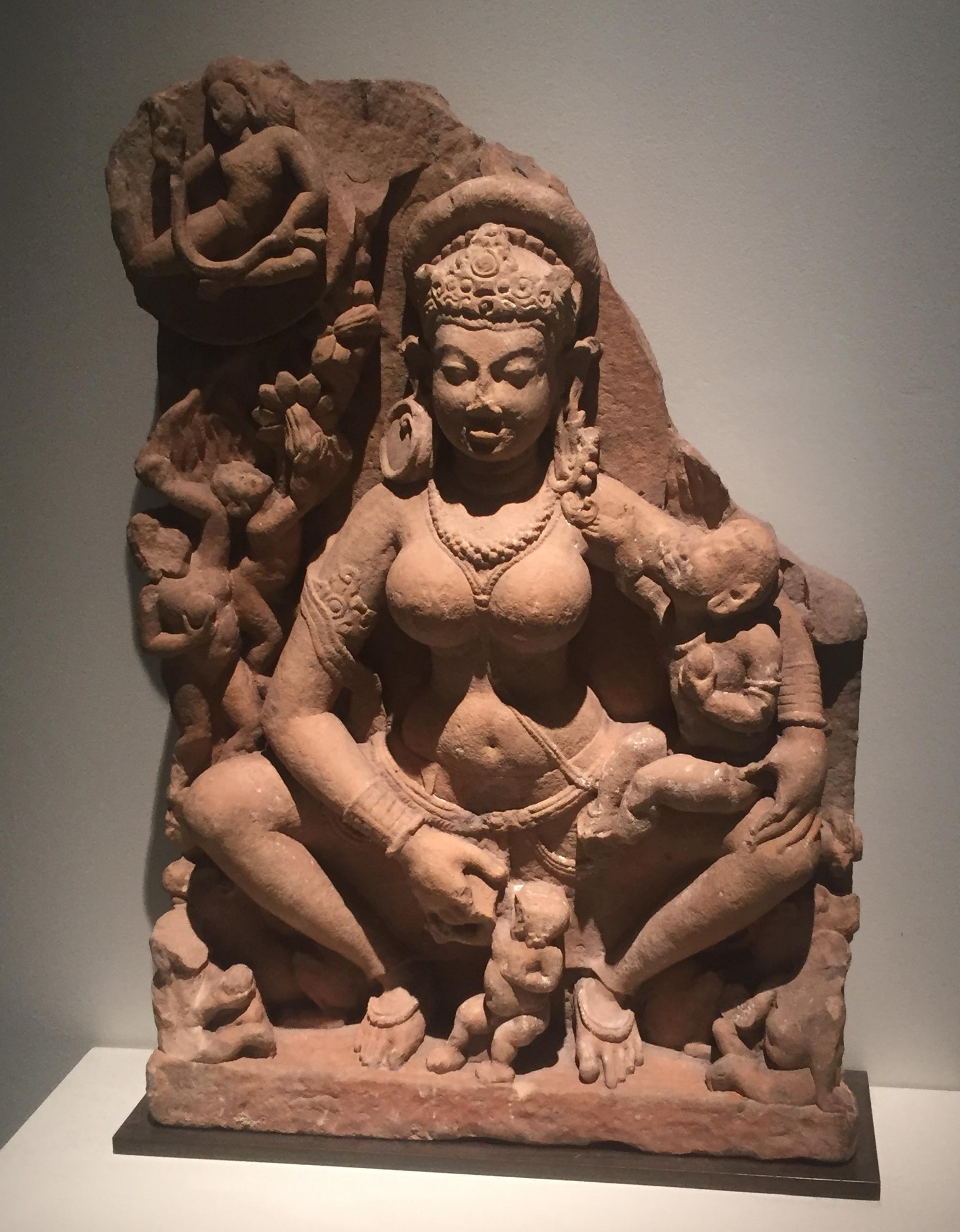
Mother Goddess
The notable part of Indian culture is Hinduism and Buddhism, so, no wonder, many of sculptures represent the gods:
Vishnu, one of three major gods in Hinduism; God of Protection, Preservation of Good, Controller of entire Universe, Karma restoration, Moksha (various forms of emancipation, enlightenment, liberation, and release)
Parvati, or Mother Goddess, the Hindu goddess of fertility, love, beauty, marriage, children, and devotion; as well as of divine strength and power.
Bodhisattva, in Buddhism, any person who is on the path towards Buddhahood.
The next part is “Central Asia Gallery”. The items presented here were mostly excavated from Xinjiang, China.
7th-8th century
Fuxi and Nuwa 7th century
6th-7th century
6th-7th century
The exhibited items were mostly excavated from Xinjiang, China, including Astana Cemetery (4th-8th century) near Turpan. The objects of the Astana tombs came to the museum from Japan, during the annexation of 1910, where they had been brought from expeditions of Ōtani Kōzui in 1905.
Fuxi 伏羲 and his sister, Nuwa 女媧, are the mythological creators of mankind. They have snake-like tails and humanlike upper part of the body. The myth of mankind creation varies depending on the source since during the thousands of years numerous Chinese nations retold and developed the myth in their specific way.
The legend fro Tianshui City, Gansu Province. There was only one old woman in ancient times. One day, she saw a big footprint and stepped on it. Unexpectedly, she has got pregnant. The old woman gave birth to a boy and a girl. After the death of the old woman, the children lived by themselves, hunted, grew up. One day it has become the time to discuss a thing of two (man and woman thing). They decided to verify the possibility of their marriage using millstones. They let the millstones rolldown from Wutai mountain. The result was the millstones matched each other, which meant they can marry. After the marriage, mankind was pullulating.
In other variants, Fuxi and Nuwa used fire smoke from two separate sources to verify the marriage; or, used clay to create people.
The next galleries are “China Gallery” and “Sinan Shipwreck Collection Gallery”.
Bodhisattva Song Dynasty
Pensive Bodhisattva Northern Qi
Northern Song
Celadon Pillow Song Dynasty
Southern Song
Late 13th – early 14th century
The last part of the “Asian Arts” is “Japan Gallery”.
1664-1660s
Noh masks 16th-17th century
Story of the 53 station of the TokaidoRoad: Yokkaichi
The other exhibition on the third floor is “Sculpture and Crafts”, consisting of 5 galleries.
“White Porcelain Gallery”. The “proto-porcelain” was invented in Shang dynasty (1600–1046 BC). By the late Sui dynasty (581–618 AD) and early Tang dynasty (618–907 AD), the now-standard requirements of whiteness and translucency had been achieved. By the time of the Ming dynasty (1368–1644 AD), porcelain wares were being exported to Europe.
Korean porcelain was first produced in the late 9th or early 10th century. The early period of the production of the white porcelain begins in 1467-1468 when royal ware was first produced at the kilns in Gwangju (a place I am going to visit later). The white porcelain is the representative pottery of the Joseon Dynasty (1392–1897) in Korea.
Seoul, 15th-16th century
15th century
“Buncheong Ware Gallery”. Buncheong ware (粉靑沙器) originated as low quality inlaid celadon produced in the late Goryeo Dynasty, but in the early Joseon Dynasty, it evolved into an entirely new type of pottery with unique aesthetic features. Buncheong ware is made by coating the surface of celadon with white mud. There are seven major methods to create the patterns (inlaying, stamping, incising, reverse inlaying or sgraffito, painting, brushing, dipping).
Stamped design and inscription 15th century
Sgraffito 15th-16th century
Incised design 15th-16th century
Sgraffito design 15th century
“Celadon Gallery”. Celadon is a type of green glaze or a ware glazed with celadon. Under the influence of China’s Yue ware, in the 9th-10th century, along with white porcelain, Koreans began producing celadon too. Later, the war with the Yuan Dynasty (1271–1368) and the Japanese invasions (late 14th century) indirectly caused the gradual decreasing of the celadon quality, which ended up with the emerge of the Buncheong ware.
Vajra is is a weapon used as a ritual object to symbolize both the properties of a diamond (indestructibility) and a thunderbolt (irresistible force). It is used symbolically by the dharma traditions of Buddhism, Jainism and Hinduism.
“Buddhist Sculpture Gallery”. When travelling around South Korea I have seen many Buddhist temples, so, it is obvious that Buddhism played an important role for hundreds of years in the history of Korea, no surprise there is a special section dedicated to Buddhist sculptures. Since the museum also is an educational centre, I discovered here quite interesting information about the appearance of Buddha in different countries and types of Buddha’s poses.
Pensive bodhisattva
Golden Buddha and Amitabha Buddha
The oldest Buddhist sculpture with an inscribed date that has ever been found in Korea, circa 539 CE.
Bhaisajyaguru Buddha
Avalokiteshvara Bodhisattva
Avalokitesvara Bodhisattva
A bodhisattva is a being who is dedicated to achieving complete Buddhahood (the condition or rank of a buddha “awakened one”). There are different classifications of the bodhisattva, containing from a couple up to hundreds of bodhisattva. However, 8 primary bodhistavas are distinguished, among them, Avalokiteśvara, a bodhisattva who embodies the compassion of all Buddhas. Previously I have seen Avalokiteśvara in Geumdangsa temple, Maisan.
Bhaiṣajyaguru – the Buddha of healing and medicine.
Amitābha – a celestial buddha.
Goryeo period 10th century
Goryeo period 10th century
Unified Silla 8th-9th century
Goryeo period 10th century
Goryeo dynasty 11th century
Views around the museum.
That is all about the National Museum of Korea. I strongly recommend to visit it because the museum exhibits a great collection of the artefacts covering various topics, it provides rich information about the history and the culture, and, moreover, the entrance is free of charge.
And, of course, such an inspiring visiting should be followed by a delicious supper!
The museum is located in Seoul, Seodaemun district. One of the reasons to visit this museum is my interest in nature, and even though the museum was located quite far away from my apartment, I decided to do it.
It was an adventure for me to find the museum. Innocently, I just followed a route proposed by an app. I had to take a subway and then to walk about 2 km to the museum. It took a long for me because any time you walk in a new area time goes slower. I went away from a noisy highway, and came to a quiet narrow street, here the app showed the final destination. But what is there? Just a private living house. I looked around, there is nothing like a big museum. The problem was that the address of the museum is quite long, so the app decided to cut the long address and led me to a point far away from the museum. The sun is burning, and I am too old for such long-distance walks, but I had to walk for about 2 more km. In addition to this, a stranger in a shop scared me, he was cursing in English loudly while talking to me and I didn’t get a word; I thought that this area is quite unusual. All the struggles worth what is awaiting me in the museum!
As I noticed, in South Korea, not only some kind of fun museums but even boring one (dedicated to very specific and complicated topics) are aimed to attract the very young audience by numerous interactive spots, one can click buttons or touch a copy of an ancient vase. Didn’t you ever want to touch some item or turn it around to have a better look on it? This museum is educational like, so the majority of the visitors are children and their parents. I am a child too since I never visited such a big museum of nature.
Everything starts from the very beginning, solar system, the birth of Earth, birth of life on Earth and so on. The website of the museum provides detailed information about the exhibitions in English.
After the orthoceras, trilobites and ammonites the dinosaurs emerge.
The millions of years flew by in a few minutes, and modern animals are here, mammals, birds, fishes, insects, molluscs and so on.
Art of nature, beetles (Chrysochoroa, Chrysina ect).
Sculptures outside the museum. That’s all about the museum, and it is time to find the way back home.
I went to another metro station by a new route through Ansan Urban Nature Park. It is a park where one can feel himself being far away from crazy city life, though the park is situated right in the city centre, so one can see the city while walking on the high paths.
After spending just a few hours in Gongju, I am heading to Buyeo, another capital (from 538 till 660) of Baekje Kingdom.
It is just one of the few cities the name I have remembered, but I have just found out that there is no English Wiki about the city, and there are just a few words in Korean (Cebuano and Svenska available). It means that no one ever would find any information about the place I have made a stop in the Buyeo country, Hapjeong village. But what is the village?
I bet this village is quite unusual because there is a big fancy shopping mall, LOTTE OUTLETS, constructed in a Korean palace style. The prices here are not for the village.
Not far from the shopping mall, there is a Baekje Historical Cultural Centre.
Here are collected things referred to the Baekje Kingdom, from jars and pots to Baekje people footprints.
A part of the exhibition represents the possible scenes of the daily life of simple people and officials and even chickens of Baekje.
A pagoda and Buddha.
Next to the Baekje Historical Cultural Centre, there is a Baekje Culture Complex. It is a Korean historical theme park, the largest one the South Korea, built to preserve the history and culture of the Baekje Kingdom. It means, everything you are going to see below is a copy.
Tombs.
Beside palaces and temples, there’s a part of the complex representing the village of the Baekje times.
There are real, huge fishes in the water.
It is time for torture and punishment.
Wouldn’t you want to live in such a huge palace with peaceful views?
Even though there is a lack of information on the Internet and the country is not a major tourist destination ***, I would really recommend visiting this place.
This year I have visited Dongducheon and Incheon. My next destination is Gongju.
Gongju (公州 ) was formerly named Ungjin (熊津), was the capital ( 475-538) of Baekje kingdom (百濟 ), one of the Three Kingdoms of Korea, together with Goguryeo and Silla.
After 1500 years, in 2004, it was proposed to move South Korean capital, Seoul, to Gongju. However, untill now, the capital relocation question remains unresolved.
Nowadays, Gongju is a quite small city, with a population of 130,000 people it is 66th biggest city in South Korea.
The date of the city foundation remains an enigma to me, nevertheless, this city is over 1500 years old! The former city’s name, Ungjin (Chinese derived pronunciation) or Gomanaru (Korean), means bear port. There’s quite an unusual legend about the city’s name. As for me, bear associates with power, strength, anger, and so on. There’s a bear’s anger in this story too, but, everything has started from love. Koreans were good at making dramas even 15 centuries ago.
Ungjin Legend
Once, a woodcutter crossed a river to go Yeonmisan mountain (燕尾山) to chop wood. Suddenly a big bear appeared and caught the man and brought him to a cave. Since that time, the bear was taking care of the man and providing the man food. Every time the bear was going for hunting, the cave’s entrance was locked with a big stone. After a few years of living together, the man and the bear have got two children (unfortunately the history doesn’t explain how did it happen).
Once, the bear didn’t lock the entrance and the man run to the river. When the bear came back home, the man reached the opposite side of the river. The bear showed the man their children and begged him to come back. But the man coldly went away. The brokenhearted bear took the children, jumped into the river and they died there.
Since then, every time a ship passes the place, there is a storm and troubles, so, a shrine was built to comfort the soul of the bear.
There’s a Russian proverb – насильно мил не будешь – a person can’t fall in love with you (or like you) if you use force for this purpose; Chinese analogue says, 強扭的瓜不甜 – if you have to use force to break a melon off the vine, it won’t taste sweet. The bear’s life ended up not sweet.
Gongju National Museum
A big copy of seoksu (石獸) stands in front of the museum. Seoksu is a stone animal statue in the image of a beast, placed at or within a tomb or palace. This statue is special because it is the first stone figure excavated buried with Baekje kings.
And this is the original statue of seoksu.
Some of the items shown in the museum were excavated from the tomb of King Muryeong: the ornament of the crown of Baekje, gilt-bronze shoes, coffins, seoksu and so on.
Beakje pottery.
Outside the museum, there’s a collection of Buddha statues.
And now, it’s time to have some food!
It is not a restaurant, just a view.
The best Korean restaurant for foreign customers in the whole Chungcheong province.
I have already visited the Chinatown, seaside on the Wolmido island. The next point is the Incheon Metropolitan City Museum!
Nearby the museum, there’s the Memorial Hall for Incheon Landing Operation.
Huge bas-reliefs, powerful walls seemed right now growing up from the ground to make reliable protection; all this convey the tense atmosphere of the landing operation days.
The flags of South Korea allies in the Korean war: Australia, Belgium, Canada, Colombia, Ethiopia, France, Greece, the Netherlands.
A view from the memorial. The city is beneath.
Time for a break. It is very hot outside, but almost anywhere inside there’s a conditioner. This is an icecream with beans. For me, this combination is quite unusual. Previously, I also found the beans in other desserts too, in different types of cookies. And I even don’t know what is stranger, to eat the icecream, or that what I am going to eat after visiting the museum…
The museum does not belong to a special category, so here all the things related to the city are collected, wether it is history documents or art objects.
Pottery. Pottery of the Neolith age, 11-12th century, and today.
This fish doesn’t seem to feel well because its eye is out of the head. The painting style makes this fish 3D-like.
Wouldn’t you want to have a dragon for dinner?
Incheon Myeong liquor bottles. In the early 1920s, there were 21 breweries, including 7 Japanese and 14 Korean.
Beer bottles of the 1920s, and a postcard with lady beer.
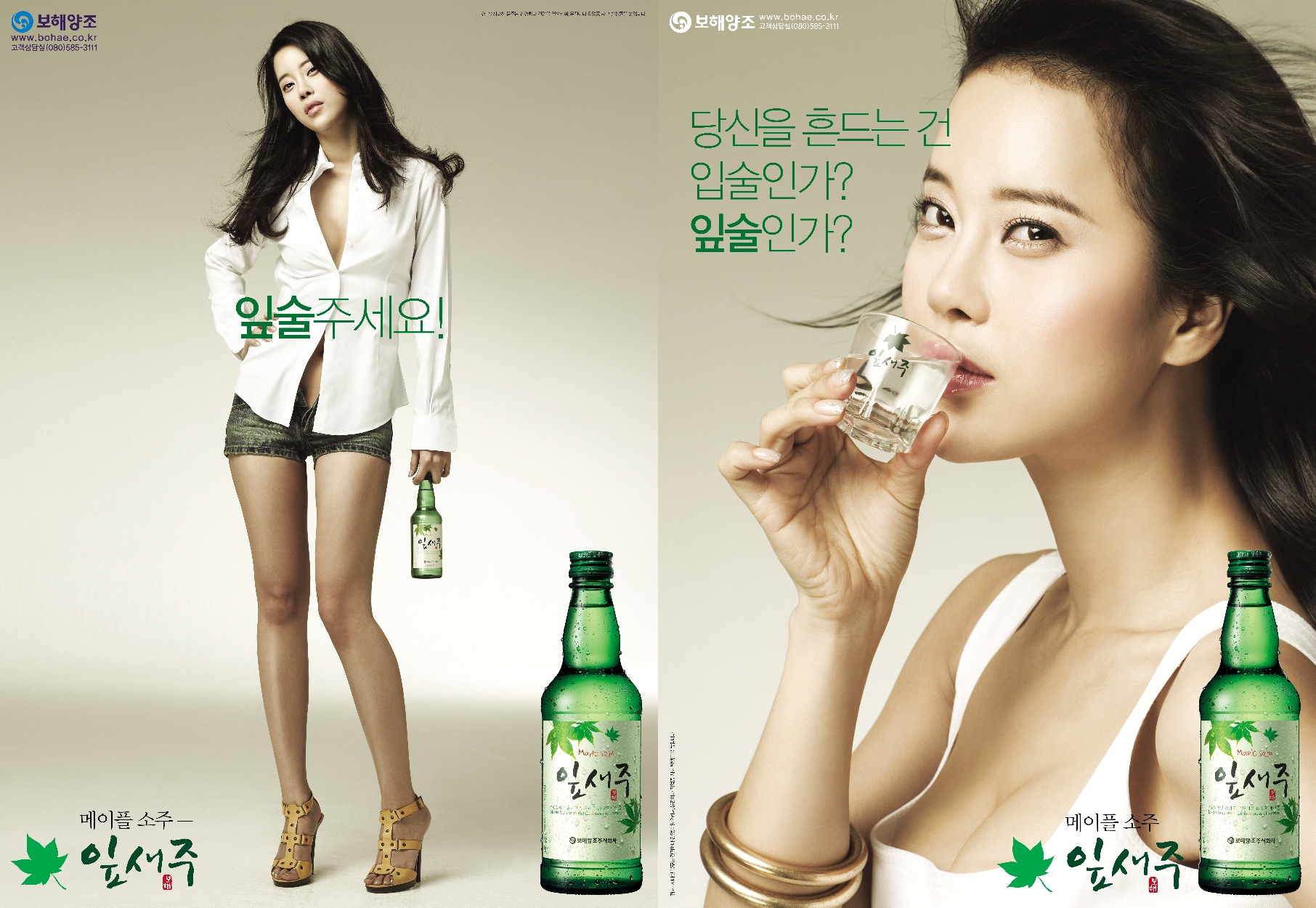
The century passed, but nothing has changed, Korean ladies still advertise beer or soju.
Cigarets, coffee and sugar products.
Stereoscope – a device to view photos in 3D, it was popular from the 1850s to the 1930s as a home entertainment medium.
Famous people from Incheon.
An epitaph (a text honouring a deceased person) from 1474 and Ganghwaji reports of 1690.
Ganghwaji was an artist from Incheon (1653 ~ 1733).These books focus on the defence strategy of Ganghwa Island.It contains information on politics, economy, history, geography, and society.
And this a text which made me crazy, so, I am going to write the whole blog about the translation!
Some more items. You can see the diversity of the items collected here.
A food-street next to the museum. I can feel a musky aroma. A poison is boiling in a vat… So, what is that?
Silkworm larva! It is called beondegi. First it like a raisin, tough outer skin and something flabby inside, a distinct musky amora, slightly bitter. When it pops, the inner part seems like chicken meat. In general, it is not bad. Only musky taste is unusual, cockroaches must taste the same.






 lezhok