Yangyang

The next destination after Hwacheon is Yangyang country washed by the East Sea.

Yangyang is not a big country too, having a population of over 27,000 people.

The area was called Yangyang 襄陽 since 1416. The area has a long history since it was known to be a part of Ye-guk 濊國 (3rd-century BC to around early 5th-century). Later it has become a part of Goguryeo and the area of Yangyang was called Ikhyeonhyeon 翼峴縣 or Imunhyeon 伊文縣. It is surprising for me, but both variants are quite nice (if compare to what I have seen before, Hwacheon, Boseong), the literal meaning is Wing Hill or That Culture (it is too complicated to find a proper translation for this pair of characters as the second character have too many meanings). Later, the name of the area was changed several times. In 1222, after a successful defend from Mongolians, it was renamed to Yangju 襄州, where the first character yang means a defender. Later the name was changed again until it has got its present name, consisting of the same yang 襄 and yang 陽, one of the meanings is the sun.

The way to the sea lies through many spots with beautiful scenes. Views from Hangyeryeong.

Even it is just a small observatory with a few buildings, there are many special souvenirs and amazing views to have some meal.

Step by step I am coming closer to ….

Naksan! Naksan is used to designate a few spots in the area, the first one I am going to visit is Naksan Beach.

I was swimming there a lot, that is why I did not take many photos. It is quite an awkward feeling to swim in a sea in Korea, because the swimming area is limited, and I could say it is much narrower than that one could be found in Odesa, Ukraine, moreover, there are so many active lifesavers, what makes the swimming quite tense, all the time I have to check if anybody of them is not running to catch me. I still remember the sea bottom there, it was shallow on the right and unexpectedly deep (for South Korea) on the left, about 2 m deep.

The other place called Naksan is a temple. Naksansa 洛山寺 was built in 671 by a scholar-monk Uisang 義湘 (625–702) who was a close friend of the man I met before in Soyosan and Namhae, it is Wonhyo. The temple is named after Potalaka mount as an abbreviation of the Chinese transcription of from Sanskrit, 補怛洛迦山. By the way, Bomunsa Temple I visited before in Ganghwa before stands on Nakgasan Mountain 洛迦山 which also is named after Potalaka mountain. The legend of the temple foundation explains the reason this name was chosen for the temple.

One of the legends says, when Uisang returned from the Tang empire, he heard that Guanyin Bodhisattva lived in the cave at the east coast of Naksan. He went there to pray and after 7 days praying he has received crystal beads from magic general Sinjang 神將, after 7 more days a dragon from the sea appeared and gave Uisang cintamani (wish-fulfilling jewel), after 7 more days Guanyin Bodhisattva appeared and said, “at the place you sit, a pair of bamboo will spring up, build a temple there”. As it is believed Guanyin or Avalokitesvara Bodhisattva lived in Potalaka mount, this place was called after the mount.

The temple has lived over many events during almost 1400 years. The last notable event happened in 2005 when the temple was burnt due to fire that started in the surrounding forest. The charred remains of the temple recall that day.

In 1925 Uisangdae Pavilion was built on the spot where Uisang once meditated.

Buddhist statue of Haesugwaneumsang. It was built in 1977. The height of the statue is 15 meters, the pedestal is 2.8 meters high.

And a beautiful sunset. Like a painting.

An interesting path to walk for leaving the temple.

My trip around Yangyang is coming to the end, but there is one more very important thing to do…

To eat unlimited sushi!

The huge crabs in the weak lights I saw on the way home reminded me of a horror movie.

That is all about my travelling around South Korea, tomorrow I have a flight back to Ukraine!

Suncheon

A long journey, the next day after visiting Sacheon and Namhae, starts with Suncheon city!

Suncheon is an average city in South Korea, with a population of 266,809 it takes 43rd place on the list of the biggest cities.

The known history of the city starts from in Samhan era, when it belonged to Mahan confederacy (1st BC – 5th AD). Previously I came across with the confederacy when I studied the history of distant from Suncheon places, Jeonju city and Muju country. It is explained by the fact, the confederacy was covering quite a big area (green). During its history, the city has changed many names, it was Sata 娑陀 (Gaya confederacy), Seopyeong-gun 歃平郡 (Baekje kingdom), Seungpyeong-gun 昇平郡 (Silla kingdom), and it is not the full list. In 1413, Taejong establishes the Suncheon Dohobu 顺天 都护府, which gave the origin to the modern name of the city. Suncheon 顺天 means by the will of heaven, obey heaven, be submissive to the will of heaven, Dohobu 都护府 is a military governorship. After many administrative changes lasting for hundreds of years, in 1995 it has become Suncheon City.

As for me, the name of the city Sata 娑陀 is quite interesting. The character ta 陀 means hillside, slope, shore or to fall down. The character sa 娑 means dancing or fluttering. Then, Sata 娑陀 might mean a fluttering hill (or, maybe, to dance until you fall down? – joke). However, maybe it was just a kind of transliteration of a Korean word. The other mentioned above names are related to peace 平, Seopyeong 歃平 bind the peace with an aouth and Seungpyeong 昇平 peaceful.

The first place I am going to visit is the Songgwangsa temple 松廣寺 (Spreading Pine Temple). It is one of the three principal Buddhist temples in South Korea representing, each representing one of the Three Jewels of Buddhism:

  • The Buddha, the fully enlightened one
  • The Dhamma, the teachings expounded by the Buddha
  • The Sangha, the monastic order of Buddhism that practice Dharmas.

This conception is resembling of the trinity conception in Christianity. Songgwangsa represents sangha. The temple was built in 867, later, it fell into disuse, but it was re-established in 1190 by Seon master Jinul (1158-1210).

Seon Buddhism origins from Chan Buddhism 禪 which was dominant in Tang and Song dynasties. Chan Buddhism also spread to Vietnam as Thiền and Japan as Zen. The word Chan 禪 origins from Sanskrit dhyāna, which means meditation leading to the “calm of mind”. Chan Buddhism started spreading around Korea during the Unified Silla. During Goryeo, master Jinul strongly influenced Korean Buddhism. That time Buddhism was seen as infected by secular tendencies and involvements, such as fortune-telling. He established a reform movement in Korea to make the correction, revival, and improvement of the quality of Buddhism. His Seon tradition is preserved well to this day.

The paintings depicting 10 bulls of Seon tradition to describe the stages of a practitioner’s progress toward enlightenment, and his return to society to enact wisdom and compassion.

  1. In Search of the Bull
  2. Discovery of the Footprints
  3. Perceiving the Bull
  4. Catching the Bull
  5. Taming the Bull
  6. Riding the Bull Home
  7. The Bull Transcended
  8. Both Bull and Self Transcended (Back circle)
  9. Reaching the Source
  10. Return to Society

Everything was fine until the bull #7 and #8. What happened to the bull? What happened to me?

The destination after the temple is Naganeupseong Folk Village 樂安邑城 .

In 1397 a fortress was constructed to protect the area from Japanese Wokou pirates. The village contains about 100 houses and government offices of Joseon dynasty.

Museum of the village.

And, cool photos of mine.

The next destination in Suncheon country is Suncheon Bay National Garden.

The area of the garden is about 1.1 km² plus 28 km² of Suncheon Bay. The area of the garden is really huge and one needs to spend hours to view all the exhibitions in the garden. I have spent over 2.5 hours, even though I skipped some parts and was almost running after my friend, giving to each exhibition just a few minutes of my attention.

There are many paths, sculptures, and nice spots for taking photos all around the garden.

One of the garden sections is World Garden Zone, representing typical features of a number of counties.

Thailand Garden. Sala Thai – an open pavilion, used as a meeting place and to give people shade. That day I really needed a shade, I was so excited so even did not pay any attention to the burning sun.

Among other, I remember Turkey, Italy, Spain, the Netherlands, Germany, Mexico, China.

A colourful bridge crosses a river and leads to a train going to the Suncheon Bay. On the other side of the river, there is also a greenhouse. The huge money tree (Crassula ovata) I found there really impressed me, how rich would I be if I have the same big plant!

The way to walk to the main spot of the bay is long, but it worth the time, power, and me.

The paths are distanced from the bay bottom, I saw crabs running there.

As long as in Ukraine nature is very strong and people are very weak, there is no need to preserve such great biomes.

This is the end of the trip around Suncheon, but not the end of trips for this day. After 2.5 hours walking around the garden, I was full of positive emotions and very surprised with my new skin tone.

National Museum of Korea

Last year I have already visited this museum, but it is huge, so, I didn’t have enough time to see exhibitions on the third floor. This year I am coming again, to complete exploring the museum.

The exhibitions of the museum are dedicated to the history and art of Korea. There are 310,000 pieces in its collection with about 15,000 pieces on display at one time. It is the sixth-largest museum in the world in terms of floor space, covering a total of 295,551 sq. m. Also, it is one of the most visited museums in the world, with 3,300,000 visitors in 2018; the first place takes Louvre with 10,200,000 visitors.

On the third floor, there are two permanent exhibitions, “Asian Arts” and “Sculpture and Crafts”. The museum has an exemplary website providing detailed information about the exhibitions, collection database, and so on.

The “Asian Arts” consists of 5 sections. The first one is “India and Southeast Asia Gallery”.

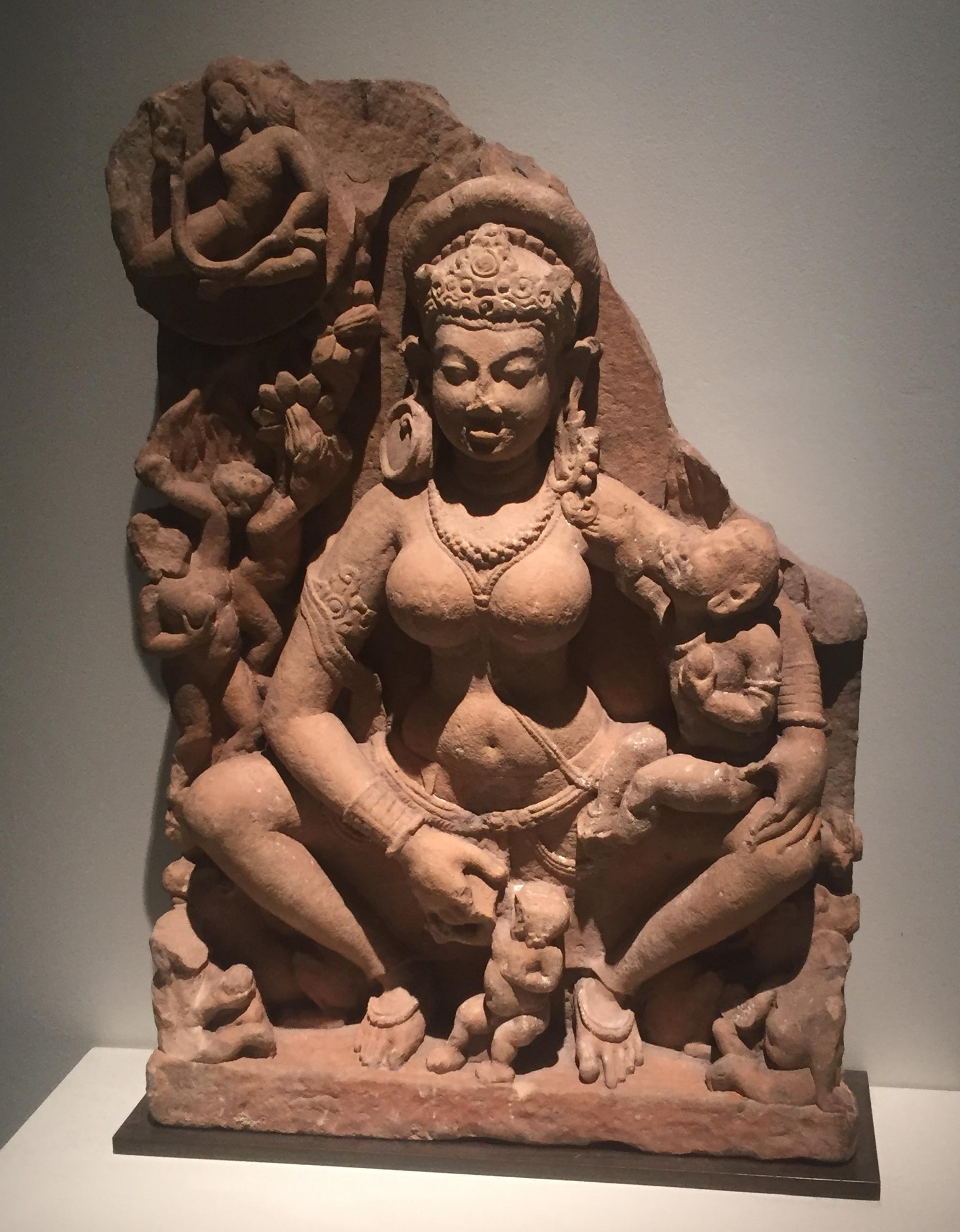
The notable part of Indian culture is Hinduism and Buddhism, so, no wonder, many of sculptures represent the gods:

  • Vishnu, one of three major gods in Hinduism; God of Protection, Preservation of Good, Controller of entire Universe, Karma restoration, Moksha (various forms of emancipation, enlightenment, liberation, and release)
  • Parvati, or Mother Goddess, the Hindu goddess of fertility, love, beauty, marriage, children, and devotion; as well as of divine strength and power.
  • Bodhisattva, in Buddhism, any person who is on the path towards Buddhahood.

The next part is “Central Asia Gallery”. The items presented here were mostly excavated from Xinjiang, China.

The exhibited items were mostly excavated from Xinjiang, China, including Astana Cemetery (4th-8th century) near Turpan. The objects of the Astana tombs came to the museum from Japan, during the annexation of 1910, where they had been brought from expeditions of Ōtani Kōzui in 1905.

Fuxi 伏羲 and his sister, Nuwa 女媧, are the mythological creators of mankind. They have snake-like tails and humanlike upper part of the body. The myth of mankind creation varies depending on the source since during the thousands of years numerous Chinese nations retold and developed the myth in their specific way.

The legend fro Tianshui City, Gansu Province. There was only one old woman in ancient times. One day, she saw a big footprint and stepped on it. Unexpectedly, she has got pregnant. The old woman gave birth to a boy and a girl. After the death of the old woman, the children lived by themselves, hunted, grew up. One day it has become the time to discuss a thing of two (man and woman thing). They decided to verify the possibility of their marriage using millstones. They let the millstones rolldown from Wutai mountain. The result was the millstones matched each other, which meant they can marry. After the marriage, mankind was pullulating.

In other variants, Fuxi and Nuwa used fire smoke from two separate sources to verify the marriage; or, used clay to create people.

The next galleries are “China Gallery” and “Sinan Shipwreck Collection Gallery”.

The last part of the “Asian Arts” is “Japan Gallery”.

The other exhibition on the third floor is “Sculpture and Crafts”, consisting of 5 galleries.

“White Porcelain Gallery”. The “proto-porcelain” was invented in Shang dynasty (1600–1046 BC). By the late Sui dynasty (581–618 AD) and early Tang dynasty (618–907 AD), the now-standard requirements of whiteness and translucency had been achieved. By the time of the Ming dynasty (1368–1644 AD), porcelain wares were being exported to Europe.

Korean porcelain was first produced in the late 9th or early 10th century. The early period of the production of the white porcelain begins in 1467-1468 when royal ware was first produced at the kilns in Gwangju (a place I am going to visit later). The white porcelain is the representative pottery of the Joseon Dynasty (1392–1897) in Korea.

“Buncheong Ware Gallery”. Buncheong ware (粉靑沙器) originated as low quality inlaid celadon produced in the late Goryeo Dynasty, but in the early Joseon Dynasty, it evolved into an entirely new type of pottery with unique aesthetic features. Buncheong ware is made by coating the surface of celadon with white mud. There are seven major methods to create the patterns (inlaying, stamping, incising, reverse inlaying or sgraffito, painting, brushing, dipping).

“Celadon Gallery”. Celadon is a type of green glaze or a ware glazed with celadon. Under the influence of China’s Yue ware, in the 9th-10th century, along with white porcelain, Koreans began producing celadon too. Later, the war with the Yuan Dynasty (1271–1368) and the Japanese invasions (late 14th century) indirectly caused the gradual decreasing of the celadon quality, which ended up with the emerge of the Buncheong ware.

“Metal Crafts Gallery”.

  • Vajra is is a weapon used as a ritual object to symbolize both the properties of a diamond (indestructibility) and a thunderbolt (irresistible force). It is used symbolically by the dharma traditions of Buddhism, Jainism and Hinduism.

“Buddhist Sculpture Gallery”. When travelling around South Korea I have seen many Buddhist temples, so, it is obvious that Buddhism played an important role for hundreds of years in the history of Korea, no surprise there is a special section dedicated to Buddhist sculptures. Since the museum also is an educational centre, I discovered here quite interesting information about the appearance of Buddha in different countries and types of Buddha’s poses.

A bodhisattva is a being who is dedicated to achieving complete Buddhahood (the condition or rank of a buddha “awakened one”). There are different classifications of the bodhisattva, containing from a couple up to hundreds of bodhisattva. However, 8 primary bodhistavas are distinguished, among them, Avalokiteśvara, a bodhisattva who embodies the compassion of all Buddhas. Previously I have seen Avalokiteśvara in Geumdangsa temple, Maisan.

  • Bhaiṣajyaguru – the Buddha of healing and medicine.
  • Amitābha – a celestial buddha.

Views around the museum.

That is all about the National Museum of Korea. I strongly recommend to visit it because the museum exhibits a great collection of the artefacts covering various topics, it provides rich information about the history and the culture, and, moreover, the entrance is free of charge.

And, of course, such an inspiring visiting should be followed by a delicious supper!

Around Gangwon

Previously I have visited Gangneung, a city in Gangwon province. Today I am going to visit few more places in this province.

The first destination is a country famous around the world as a host country of the Winter Olympics in 2018, Pyeongchang.

I have spent a night here after visiting Gangneung, and by the afternoon I left this place, so nothing much was explored.

On the way, I discovered one quite attractive spot. It is Baekseok waterfall 白石瀑布. It is located it Najeon-ri, Bukpyeong-myeon, Jeongseon country.

A funny thing about the waterfall is that from this observation point water seems to fall from the highest point of the mountain like it is erupting from a volcano. To my best knowledge, the tallest waterfall of South Korea is Ojang waterfall 五臧瀑布 (127 m), also located in Jeongseon country. So, Baekseok is one of the tallest waterfalls in South Korea.

Jeongseon country 旌善郡 appears in history as Ingpaehyeon 仍貝縣 during Goguryeo Dynasty ( 37 BCE–668 CE ) and gets the present days name in 1012. The character jeong 旌 means a flag or to honour; the character seon 善 have many positive meanings and can be translated into English as good, beautiful, good, kind, excellent, best; kindhearted, hospitable, friendly; auspicious, happy. Then, Jeongseon may mean to honour goodness. By the way, the name of the tallest waterfall, Ojang 五臧瀑布, contains character jang 臧 which also can be a synonym for seon 善, however, oajng 五臧, as 五藏, usually is referred to five classic books of Buddhism or five organs of a man (heart, liver, spleen, lung, kidney).

The next destination in Jeongseon is Jeongamsa Jeogmyeolbogung temple 淨岩寺 寂滅寶宮.

The exact date when the temple was built is unknown, but, it is believed that it was built by Silla queen Seondeok (died in 647), who is the first reigning queen in the history of Korea. Jeogmyeolbogung 寂滅寶宮, nirvana precious palace, is a type of temples built during Silla to enshrine Shakyamuni Buddha, the founder of Buddhism. A specific feature of this kind of temples is that there are no Buddha statues because there are remains of the Buddha’s body (사리, 舍利, śarīra). Here, the sarira is stored in the Sumano Pagoda 水瑪瑙塔.

The pagoda is made up of gray-green limestone bricks, due to this, it has got name Sumano 水瑪瑙 – watery agate.

Another specific feature of the temple is wind bells, punggyeong 風磬, with fishes hanging on bell-clappers.

And the river rapidly flowing down makes beautiful scenery.

It is time to move on!

From Jeongseon country we entered to Taebaek city. Here the plan was to visit Hambaeksan mountain, but, for some reason, the way was locked. So, I just had a chance to look around on the roadside.

Being not far from the border between Jeongseon and Taebaek, after a short time we entered Jeongseon again, and found an unplanned attraction here!

Manhangjae forest park. It is a perfect place to enjoy the variety of mountain plants and insects accompanying them. Many people are resting there, having picknics; there’re many nice paths to walk around, photo exhibition, and information stands about the local plants. There diversity of the plant species must be really great because I didn’t see many of the plants shown on the stands, maybe it is not the time for those species.

It is not yet all about Gangwon province, but it is time to move on!