I am going to visit some places in Seoul, the majority is must to be visited by any tourist.
Changdeokgung Palace
Changdeokgung Palace (昌德宮) is one of the “Five Grand Palaces” built by the kings of the Joseon Dynasty. 13 buildings and 28 pavilions are located throughout the area of 58 ha, making the palace a kind of labyrinth. When I walked around the palace, sometimes I wandered to silent deserted nooks, sometimes I was lost and couldn’t understand where am I, but the magnificent environment wouldn’t fire any spark of disturbance. This place is great to spend a few hours on a walk and to feel Korean culture.
Deoksugung Palace
Deoksugung Palace (德壽宮) also is one of the “Five Grand Palaces”. While standing near the entrance for some time, I saw so many foreigners coming inside. I guess this place is really top on the list of trip advisors. My aim here is Deoksugung Art Museum.
After visiting Soyosan and Deogyusan I understand from what the painters get an inspiration
Gyeongbokgung Palace
Gyeongbokgung Palace (景福宮) is the largest of the “Five Grand Palaces”. I visited it with my Thai friend I met in Kyiv, who works in Seoul now.
Namsan Tower
YTN Seoul Tower, or Namsan Tower, is a communication and observation tower located on Namsan Mountain. It is the place where you can observe Seoul from high. Also, there are many love padlock. The place like a magnet attracts hundreds of tourists. I saw there the whole student groups from China. It is my second time here, and the same, I am using a cable car to get up on the mountain. Maybe next time I should climb!
Street Views
Business centres, uncountable small restaurants and stores, markets, protests – it is a contrasting Seoul.
Dongdaemun
Dongdaemun (東大門 – western big gate) is a district in Seoul. There is a Russian area, with post-Soviet Union member countries restaurants and shops. It is one of my favourite places to hang out, maybe because it is in the city centre, a suitable metro station is near, there are shopping malls and quiet alleys, and my favourite channel where I like to relax and have some beer is near too. I will come here again a few more times during this trip. When I am there, I am feeling like my home is somewhere around, even it is 7000 km away.
I had some beer with my friend near the channel, then we went to a bar where I had tried a few more types of beer. It was a great time!
After Jeonju and Jinan, my next destination is Muju country!
Muju (茂朱郡), like the neighbouring Jinan, is a small country with a population of about 25,000 people. Nevertheless, the history of the county lasts for centuries. The present-day Muju before belonged to two states. During the Samhan era (before the 4th century), separated by the Sobaek Mountains from the north to the south, the east side belonged to Byeonjin (a loose confederacy of chiefdoms) and the west side belonged to Mahan (I met this confederacy in the history of Jeonju). During the Tree Kingdom period, Mahan was a part of Baekje and the Byeonjin was a part of Silla. The part of the area belonging to Byeonjin, Mupung (茂豊) was renamed by Silla to Musanhyeon (茂山縣), and the area belonging to Mahan, Jugye (朱 溪) was renamed to Cheoncheon-hyeon (赤 川 縣). Later, Musan (茂山) was renamed to Mupung (茂 豊), and Jeogcheon (赤 川) was renamed to Dancheon (丹川). Later, Dancheon (丹川) became Jugye (朱溪). And, finally, during the king Taejon reign (same as in the history of Maisan mountain), combining names of two areas, Mupung (茂 豊) and Jugye (朱溪), the present name Muju (茂朱郡) appeared. It is the only name of the city or country in South Korea ending with ju which is 朱 but not 州.
In Muju, I am going to visit Deogyusan National Park, or rather, the cornerstone of the park, Deogyusan mountain, covering portions of not only Muju country but Jangsu county too.
The mountain is quite high, so it is much easier to take a cable car to get on the top of the mountain.
The way up wasn’t that quick as I expected, so I even had time to imagine how the cabins fall down and crash, or don’t crash, depending on the surface beneath.
The first thing I felt when I went out of the cabin was the freezing air! It is so hot at the foot of the mountain, and cool on the top. That time I remembered a geography book I read at school, every 1000 m up the temperature decreases by 6 degrees, such a nice lesson. But, even if the temperature would be below zero, and I am wearing summer clothes, I wouldn’t go back, the views there are amazing!
The higher you climb, the more and more amazing the views become.
1614 m. To my best knowledge, Deogyusan is the 4th highest mountain in South Korea (omitting the fact that the second-highest mountain, Jirisan, have 9 higher peaks).
I was very inspired by the environment, so, only when the of cable car working hours was running out and I started walking back quickly, I realized that the way I walked to the peak was significantly long.
And the way was even longer because I couldn’t pass by the mountain plants or the suspicious sounds – I saw a rodent, probably a chipmunk. I came to a dead tree with many holes looking for the animal but it didn’t show up.
I could recognize only elderberries and magnolias. We have the yellow flower in Ukraine, but the one I capturer here is more glossy.
Back to the hot ground. And move on!
We had a quick stop in Geumsan country to buy ginseng. Should I count the 30 minutes I spent there as visiting?
All the roots look the same to me, but the price is different, and all the sellers on the market are selling the same ginseng but they are so many.
The next destination after Jeonju is Jinan (鎭安) country. Characters 鎭安 might be translated as square off; to establish order and calm; to strengthen. This name was formed during Silla times, in 757, by abbreviation, or a kind of transformation of the former name, Nanjina (難珍阿). The middle character jin 珍 (a pearl, jewel) have the same pronunciation as jin 鎭 (here, comfortable and good for living), to emphasize that this region is good for living, as the former name supposes some difficulties nan 難, accoring to records, people in the region are simple and economically very poor***. There was another name of the country, Wollang (月浪, 越浪), moonlight or over a wave.
Jinan is a small country with a population of about 24,000 people.
It is such a pleasure to read the article about Jinan Country on Wiki, one can feel this place is unique and the best (at some moment I thought the author of the article is a graduate of North Korean university). For example, the only double-peaked mountain in the world is situated in Jinan the Maisan mountain. I was very surprised and found a list of the mountains with two peaks (double summit). It is not the only one in the world, nevertheless, I am going to visit it!
To get to the Maisan, one has to overcome a few challenges to prove the physical strength and willpower. Of course, one of the trials is climbing up a hill under the burning sun. Another one is to stand against invitations to the plenty of delicious restaurants on the alley. Huge cherry trees are growing up along the alley. There were just a few people walking, however, this place might serve many visitors.
The next spot after the alley is Geumdangsa temple (金塘寺). The character geum 金 means gold, dang 塘 means square pond, and sa 寺 – Buddhist temple, so the whole name means Golden Pond Temple. It was built in 814, during Silla.
The hanging painting of the Avalokitesvara Bodhisattva, embodying the compassion of all Buddhas. It was painted in 1686. And turtles.
Here is the square pond (dang 塘). A small piece of the Maisan appears from behind the hill. Maisan (馬耳山) means Horse’s Ear Mountain. Guess why?
The closer I come, the more the ear shows up. From this point I could see only the one ear, actually, there are two ears. Until we reached a temple and I saw a sign with the temple’s name 馬耳山塔寺, my friend was saying it is a cow’s ear, and actually, it pretty looks like a cow’s ear. During Silla, the mountain was called Seodasan (西多山 – eastern numerous mountains), during Goryo Yongchulsan (龍出山 – dragon come out mountain), and Sokgeumsan (束金山 – to tie a golden mountain, hard to translate, I think it is like to tie a horse in a bridle) during early Joseon, until it has got the present name, Maisan (馬耳山 – horse’s ear mountain) during the reign of the king Taejong.
On Maisan there is Korean Buddhist Temple Complex, Tapasa (Pagoda temple) and stone pagodas. It is founded by Yi Gap Yong, a lone Buddhist hermit layman, in 1885. He has built as many as 120 conical natural stone pagodas, all without mortar.
In one day I have visited Gongju, Buyeo and Gunsan. The final destination of the day is Jeonju! By the time we arrived at Jeonju, it was quite late, so the only thing we could do that day is to have an amazing dinner.
And it is a really good choice, as in 2012 Jeonju has become a UNESCO City of Gastronomy, a category of a UNESCO programme Creative Cities Network. By the way, there are 7 South Korean cities recognized in different categories, while from Ukraine there’s only the only city, Lviv, a City of Literature.
Night Jeonju street
Here we are! Seems, a simple Korean restaurant; first, some alcohol from a teapot and then plenty of dishes that even don’t fit the table, so the waiter sometimes have poured some dishes from the separate plates to the one plate.
Korean dishes are served with several side dishes, at this restaurant, there were over 30 side dishes and, frankly speaking, I don’t even know what some of the dishes are. There were various types of the seafood: shrimps, clams, rays, squids, crabs, fishes, caviar; vegetables: potatoes, turnips, cabbages, beans, pumpkins, seaweeds, peppers; meat and eggs; and of course silkworm larva! After such a boom of the tastes, who would care about the main dish.
I will discover Jeonju next day!
Jeonju (全州) is 16th largest city in South Korea with a population about 652,000 people. Jeonju used to be a capital of the Later Baekje Kimgdom.
The name of the city Jeonju (全州) means a perfect region. This name was established in 757. It origins from the previous name of the city, Wansanju (完山州). The first character wan 完 was replaced by close by meaning jeon 全. On the other hand, the origins of the character wan 完 in the city’s name usually is referred to the Mahan confederacy, namely, to the Wonsanseong (圓山城) castle of Mahan or a small nation of Mahan, Wonjigug (爰池國), where both won 圓 and won 爰 have the same pronunciation including the tone. Then, won has become wan 完, due to similar pronunciation.
An interesting thing about Jeonju is that it was regarded as the spiritual capital of the Joseon Dynasty because the Yi royal family originated there.
The city does not have the industrial infrastructure, manufacturing, or heavy industries found in other Korean major cities. Today, traditional touring and sightseeing is a major industry in the city.
Street views. We had a walk around the Jeonju streets, it was hot and quiet, some shops still weren’t opened. And then we saw an activity going on…
Many foreigners dressed up in Korean traditional clothes were walking around and taking selfies and group photos. It is Jeonju Hanok Village!
Jeonju Hanok Village
Hanok ( 韓屋 – Korean house) is a traditional house first designed and built in the 14th century during the Joseon Dynasty. There’re a few common shapes of the houses, ㄱ-like and ㅁ-like (in cold areas). The houses are built with respect to the environment, namely, the house is built with a mountain in the back and a river in the front.
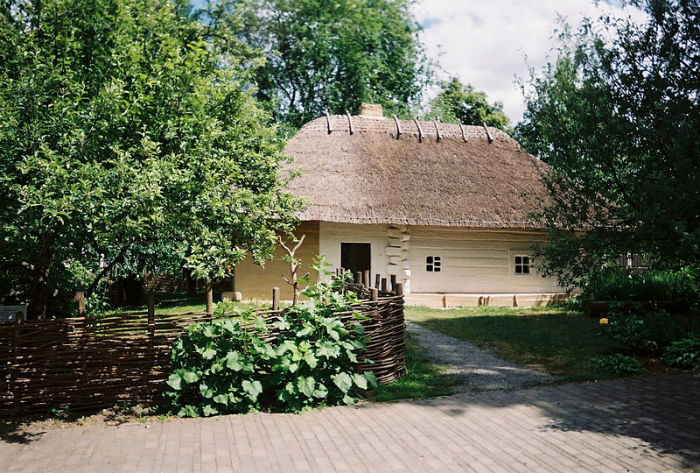
Ukrainian hut
When talking about Ukrainian traditional houses (khata, English analogue – hut; probably originating from Proto-Indo-European language), there were many requirements too, among them, the entrance should be to the south or to the east, and many restrictions about the place for the new house (one can’t choose a place where someone was killed, or there were many quarrels, or there was a road, or someone threshed grains there and so on).
There are over 800 hanok in Jeonju village. The village is located in the city centre, it makes the village “urban-like”, not a traditional one. Millions (7.8 in 2014) of tourists are visiting this place yearly, making Jeonju 4th major tourist city in South Korea after Seoul, Jeju and Busan.
Pretty streets full of good spots for a photo, small squares and channels, and many attracting sculptures – a walk here won’t bore you, only bring a feeling of peace and inspiration. I have got a prediction for my future (red ball) but my friend couldn’t understand difficult Korean so still, I don’t know what is awaiting me.
Seonyudo (仙遊島) is a small island in Gunsan city (群山市), with area about 2 km sq. and a population of 500 people. It used to be a port on the Song-Goryo trade route. Also, during the Goryo times, there was a naval base, and periodically the island was becoming a battle place. Nowadays, the island attracts many people too, but for the joy, not the fight. There are so many references on the Internet about this place!
The original island name was Gunsando (群山島). The naval base situated on the island was called Gunsan-jin (群山鎭). Later, the base moved to the mainland. Together with the base, the island’s name moved too, giving the present name to the Gunsan city.
The name 群山 might be translated as mountains or a group of mountains, right that what you can see on the island. The name Seonyudo 仙遊 is said to have been called because of the beautiful scenery of the island and the freshness of the island, while the direct meaning of the 仙遊 is a trip of an emperor or wanderings of celestials.
The evening is coming soon, it is time to move on!
After spending just a few hours in Gongju, I am heading to Buyeo, another capital (from 538 till 660) of Baekje Kingdom.
It is just one of the few cities the name I have remembered, but I have just found out that there is no English Wiki about the city, and there are just a few words in Korean (Cebuano and Svenska available). It means that no one ever would find any information about the place I have made a stop in the Buyeo country, Hapjeong village. But what is the village?
I bet this village is quite unusual because there is a big fancy shopping mall, LOTTE OUTLETS, constructed in a Korean palace style. The prices here are not for the village.
Not far from the shopping mall, there is a Baekje Historical Cultural Centre.
Here are collected things referred to the Baekje Kingdom, from jars and pots to Baekje people footprints.
A part of the exhibition represents the possible scenes of the daily life of simple people and officials and even chickens of Baekje.
A pagoda and Buddha.
Next to the Baekje Historical Cultural Centre, there is a Baekje Culture Complex. It is a Korean historical theme park, the largest one the South Korea, built to preserve the history and culture of the Baekje Kingdom. It means, everything you are going to see below is a copy.
Tombs.
Beside palaces and temples, there’s a part of the complex representing the village of the Baekje times.
There are real, huge fishes in the water.
It is time for torture and punishment.
Wouldn’t you want to live in such a huge palace with peaceful views?
Even though there is a lack of information on the Internet and the country is not a major tourist destination ***, I would really recommend visiting this place.
This year I have visited Dongducheon and Incheon. My next destination is Gongju.
Gongju (公州 ) was formerly named Ungjin (熊津), was the capital ( 475-538) of Baekje kingdom (百濟 ), one of the Three Kingdoms of Korea, together with Goguryeo and Silla.
After 1500 years, in 2004, it was proposed to move South Korean capital, Seoul, to Gongju. However, untill now, the capital relocation question remains unresolved.
Nowadays, Gongju is a quite small city, with a population of 130,000 people it is 66th biggest city in South Korea.
The date of the city foundation remains an enigma to me, nevertheless, this city is over 1500 years old! The former city’s name, Ungjin (Chinese derived pronunciation) or Gomanaru (Korean), means bear port. There’s quite an unusual legend about the city’s name. As for me, bear associates with power, strength, anger, and so on. There’s a bear’s anger in this story too, but, everything has started from love. Koreans were good at making dramas even 15 centuries ago.
Ungjin Legend
Once, a woodcutter crossed a river to go Yeonmisan mountain (燕尾山) to chop wood. Suddenly a big bear appeared and caught the man and brought him to a cave. Since that time, the bear was taking care of the man and providing the man food. Every time the bear was going for hunting, the cave’s entrance was locked with a big stone. After a few years of living together, the man and the bear have got two children (unfortunately the history doesn’t explain how did it happen).
Once, the bear didn’t lock the entrance and the man run to the river. When the bear came back home, the man reached the opposite side of the river. The bear showed the man their children and begged him to come back. But the man coldly went away. The brokenhearted bear took the children, jumped into the river and they died there.
Since then, every time a ship passes the place, there is a storm and troubles, so, a shrine was built to comfort the soul of the bear.
There’s a Russian proverb – насильно мил не будешь – a person can’t fall in love with you (or like you) if you use force for this purpose; Chinese analogue says, 強扭的瓜不甜 – if you have to use force to break a melon off the vine, it won’t taste sweet. The bear’s life ended up not sweet.
Gongju National Museum
A big copy of seoksu (石獸) stands in front of the museum. Seoksu is a stone animal statue in the image of a beast, placed at or within a tomb or palace. This statue is special because it is the first stone figure excavated buried with Baekje kings.
And this is the original statue of seoksu.
Some of the items shown in the museum were excavated from the tomb of King Muryeong: the ornament of the crown of Baekje, gilt-bronze shoes, coffins, seoksu and so on.
Beakje pottery.
Outside the museum, there’s a collection of Buddha statues.
And now, it’s time to have some food!
It is not a restaurant, just a view.
The best Korean restaurant for foreign customers in the whole Chungcheong province.
Soyosan is a mountain located between two cities, Pocheon and Dongducheon.
Previously I mentioned the Soyosan metro station of the blue line; so, now we know why the metro station has this name. In Chinese, the mountain name is 逍遥山. The character 山 simply means “mountain”. Two characters 逍遥 might be translated into English as “wandering around at leisure”, “wander for pleasure”, “to be blissful”, “unrestrained”, “free”, “freedom”, “serenity” and so on. So, I would translate the whole name as the Mountain of Freedom or the Mountain for Pleasurable Wandering. Actually, that is what people do there, wander, enjoy the time, feel free and easy there.
For many centuries, the mountain was a spiritual place attracting thinkers and monks. Thus, in 654, during the Silla Kingdom, Wonhyo, a priest and commentator of the Korean Buddhist tradition, found Jajaeam (自在庵 ) temple, which exists till now. I planned to visit it too, and I would if the walk doesn’t kill me. By the way, the temple name might be translated as Monastery of Freedom: 自在 “to feel free” or, “free” as Ishrava in terms of Buddhism, and 庵 “Buddhist monastery”.
On the way to Soyosan mountain.
The entrance
Hardly, but, since I am almost a professional small seal script translator, I have resolved the inscription on the gate. Of course, that happened not without the help of the almighty Internet. I applied the same algorithm I used to resolve the sentence from the museum: just search the characters I found and hope the rest of undefined characters will appear in the sentence. This time it wasn’t that easy, there was no such combination of the words. I have noticed that the characters in the gate name 逍遥山 自在庵 are spelt from the right to the left, which is unusual for me; then, I reversed the sequence of characters I recognized, added 逍遥山 and searched again. It was a success.
京畿小金刚
The problem was in 京 and 金, which I thought might be 金, but, after checking all the possible spelling styles, I gave up. I guess the task would be much easier if I know that the province Gyeonggi in Chinese is spelt as 京畿. The Chinese Baidu gives such an explanation, “In the spring, azalea and hawthorn flowers form a magnificent scenery, and the autumn leaves are also very charming, so the mountain is known as the Diamond of Gyeonggi“.
My friend recommended me to climb up the hill by the route #4 to the Gongjubong peak, then go to the highest point, Uisangdae and then go down by route #2. That seemed easy to me, so I started running up!
The majority of the visitors are ancient haraboji (grandfathers) and halmoni (grandmothers), relaxing, sitting, eating, playing games; some of them even climb high up to the peak. Why are there only old people? The first reason is that youngsters are at schools and workplaces at that time. The other reason is that the area is highly populated by old people. They don’t want to live in the noisy crazy metropolitans, they want to feel the calm and relaxation, come closer to nature to feel free.
I was walking and walking, plenties of paths changed, plenties of people passed by on the way down, but the first peak was not showing up through the impenetrable forest. Each time I climbed a plateau I was just shocked that is not the peak.
At some moment I climbed high enough to see one of the peaks, this inspired me.
Then a plateau with a nice view appeared, however, that wasn’t the peak yet. A haraboji was there too.
While climbing, I was hunting wildlife and ancient items too. Maybe a 삵 sag or a 담비 dambi is living in the hole.
Finally! A view from the Gongjubong peak, Dongducheon beneath. The next step is to reach the highest point of Soyosan, Uisangdae peak.
I was really surprised when saw the stair going down, I expected I have to go only up, it is more tiring.
Less than a kilometre left.
This view reminds me of the classic oriental paintings, far blur sky one background and the fir growing like a haze to match the environment.
And here it is! 587 m! This is the highest mountain I climbed. It is very hard, as you can see, to climb to the very top of the peak, I am surprised how elder people doing that. The guy on the photo smiled and said passing his phone to me, “Camera, please”.
After this moment, everything went wrong. I supposed to easily go down by the route #2, so I passed further. I came to a plateau, there was a sign, showing to the left. So, I went that way.
Periodically the path was hard to find, going down, it was becoming less and less recognizable. Sometimes I heard the voices talking somewhere around. I was just going down and surprised, why this route is not as well organized as the path #4. Finally, I came to a very steep cliff. I thought, “That’s why my friend recommended me to go up by the path #4, path #2 is really hard”. Then, I had to slide down from a cliff about 2 m height. Space there was very narrow and the next cliff was narrower and much lower. “Should I jump?”. Then I thought, “Hm, there’s something wrong”. And I realized that the game is over. That what I am doing is very dangerous. If I fall down, nobody is going to find me and I will die. I decided to climb up and find the right way. Actually, climbing up the cliff was much harder because I needed to pull up, it was hard to find something to hold to.
I have contacted my friend, he told me I am on the right way. I was just wandering around and looking for anything like a path. Finally, my friend recommended me just to go back in the same way. I said, “No, I am so far away from there, I will just find the right way”. He said, “OK, you can die”. After some period of time, I decided to back to the way I came here. I thought I will just quickly go back to the plateau with the sign, and then back to Uisangdae, then a little bit more to Gongjubong and then finally go down. But, when I started climbing up, I felt that I am absolutely exhausted, dehydrated, my heart was crazily beating, huge dozes of blood were almost tearing up my neck. By the time I reached the cliff, I was walking down for about 20 minutes already. When climbing up, I had to make stops every 10 meters to calm down, because my heart was near to burst. From the 0.5 l of water I had on the beginning, almost nothing left. I sipped I bit and dream about gallons of water I am going to drink when I come back to the city. Another horrible thing is that I forgot my power bank at home (actually, I thought I lost it), what almost never happens. I wasn’t trying to save the charge of my phone, because I relied on the power bank. And here, I am almost dead, and the discharged phone kills me more!
Later I showed the sign to my friend, it was correct, but I didn’t find the path #2. I was passing by all the narrow or wide, steep or flat paths I have seen on the way to Uisangdae and I couldn’t wait until this adventure to be finished.
I remember I was resting for a few times on the steep stairs I saw when going from Gongjubong to Uisangdae. There was almost no one, but I didn’t want anyone to find me and call an ambulance.
After reaching the Gongjubong peak I felt relief. Even thou my legs were shaking, and the way down seemed became much longer, I walked with big steps given up to the gravity.
When I reached the root of the mountain, I remembered that still there is a long way to the shop. I bought one bottle of water while waiting for my friend to pick me. Then one more. And I started the third one.
This day I walked almost 12 km, 18000 steps and 229 floors! This is my record on “floors”.
The day ended up with a dinner cooked by my Korean mother. Chick stuffed with rice, ginseng roots and other seasonings.
Songdo International Business District is a smart city, i.e. computers are built into the buildings and streets, special sensors gather information on things like traffic flow and energy use and so on. The city development project cost in excess of $40 billion, making it one of the most expensive development projects ever undertaken. By 2025, the 102 Incheon Tower to be built, it will become the tallest twin towers in the world. As of 2018, the population of Songdo exceeds 100,000 people. Along with Yeongjong and Cheongna, it is part of the Incheon Free Economic Zone.
Songdo Central Park. The plan of the park was inspired by New York City’s Central Park.
A yawning man on the bridge.
This neo-futuristic metallic building is a Tri-Bowl, it is a multi-complex culture and art centre built to seem as if it is floating on water.
A view on the city through the Tri-Bowl arc.
In the front view, the buildings look crooked.
Sculptures of different styles can be seen in the futuristic park, however, they naturally suit the environment.
Northeast Asia Trade Tower, South Korea 4th tallest building with a height of 305 meters, 68 floors. And me, drinking a beer there.
And now I am heading to the last destination in Incheon.
The Incheon Bridge, with 21.38 kilometres length is it the longest spanning cable-stayed bridge in South Korea and 10th in the world.
The bridge connects the mainland with an interesting place you can see on the map below. From 1992 to 1994, 4 islands were connected to provide space for the Incheon airport. The new-formed place is called Yeongjongdo. Even it is a whole part of the land, the islands are meant to be islands, so you can travel from one island do another by land, sounds fantastic if you are not familiar with the situation.
Seems it is a new bridge, so the info wasn’t uploaded yet, the car is in the water.
So, I am coming for dinner on the seaside!
Seafood on the seaside! Just look at that huge shell. I have never seen such a big shell. The clams are cooked immediately in the stove.
It was Incheon and only one day. I hope I can move on and complete review of all the places I have visited in South Korea if I have enough free space on the WordPress, 12% is occupied already.
In an Incheon museum collecting various items, I saw a text written by old Chinese characters. At first sight, I could recognize only “water” character (the second on the left, it looks like a river). I felt curious about the whole meaning of the text. So, I started to find the way how to translate it.
While looking for any info about the old Chinese Characters, I found that this calligraphic style is called small seal script 小篆. This style as standardized was introduced into usage in 220 BC, the year after Qin’s unification of the Chinese states. Before the Qin conquest, local styles of characters had evolved independently for centuries.
There’s a table of the small seal script radicals on the website. One just needs to choose the radicals from the table which are present in a character, the system will show all the characters containing chosen radicals, one needs to find the considered character among the proposed. The web site provides detailed info about the character’s evolution. But, that’s not as easy as it could be, because the style is shown on the photo actually differs from small seal scripts.
Here are the styles of character 文, however, the third one of the left doesn’t seem to look like any of those. The thing worrying me is that there’s no dash on the top of the character on the photo. As you may know, each dash or line, its position and incline very matters, so, there’re some characters which look similar, however, have an absolutely different meaning. Just have a look at two modern characters, 孑 and 子, meaning lonely and son respectively. So what to say about the ancient characters.
I found supposed alanog of the 6 left characters, but the bottom one of the left made me crazy. The only one familiar to me radical was 土 “ground”. The upper part of the character looked like a jumping frog with front legs up and fingers on the back legs. The fingers attached my attention, so I was looking for radicals with “fingers”, red circles on the picture. I was looking over the table, again and again, trying different combinations, and didn’t succeed. Actually, it was there (green circle), but I saw it only after I found resolved the whole sentence.
How did I solve the whole sentence? I just searched the few supposed modern characters, and succeed. Fortunately, it is a well-known sentence. After that, the frog has become a deer.
Here you can see the characters I supposed to be the bottom one, however, none of these was right. In the small seal script the character should look like one of these:
Here are other suggested styles of the character 塵 (traditional) or 尘 (simplified):
This sentence in small seal script should look like this:
There’re some deviations in the style, but the sentence is resolved!
About origins
When looking to the origins of the character 塵, I can guess why does it mean “dust”. Probably the inventor was thinking about running deers who rise up the dust from the ground. Nevertheless, simplified Chinese character 尘 is not devoid of logic, the top part 小 means “small”, together with 土 “ground” or “soil” makes “small soil” or “small piece of the soil” which is “dust”.
I was curious about there the deer’s legs and horns are 鹿, so looked up for the origin of the character.
There’s a big gap between these symbols and the present appearance of the character 鹿.
The character 秋 have an interesting origin too:
It looks like a bug (supposed to be a dragonfly), and the bug doesn’t seem to feel well, maybe it’s dead or burned on a fire, dried. The modern character 秋 for “autumn” burns (the remains of) the crops after it been matured and harvested.
So, coming back o the sentence, in simplified Chinese, it looks like:
春风大雅能容物 秋水文章不染尘
And traditional Chinese:
春風大雅能容物 秋水文章不染塵
The funny thing about the sentence it was written long after the small seal script stoped to be used. The author of the sentence is Deng Shiru 鄧石如 who lived in 1739/1743–1805, during the Qing Dynasty. He was a Chinese calligrapher who travelled around eastern and southeastern China to study specimens of rock calligraphy and the stele. He made hundreds of copies of Han and Wei dynasty monuments. Based on the achievement of the calligraphers of the Han, Tang dynasties, he developed an organic and individual combination of different ancient variants of handwriting.
What the calligraphic style is used in the photo? I didn’t find the answer to this question. I found a translation of the sentence into English:
“The wind of spring is great to contain all things, the article like water of fall that keep away from dust”
The comments of the sense of the sentence I found on the Chinese Internet usually are very similar. I suppose people use the same source to make own opinion. Here is one of the explanations: “The spring breeze has the inclusive feeling of accepting all things. The words and phrases are like autumn water, and they are not contaminated with the dust of the world”.
I am a little bit disappointed with the meaning of the phrase and I do not really understand it even after thinking about it for some time. But I am very happy with that I found something new. And now I know how to easily write text in old Chinese. Sometimes, when I was historical dramas, I am thinking about to have a folding screen with Chinese characters on it. Moreover, now I can write whatever I want.




 lezhok