After the intensive trip around Suncheon, I am heading to a neighbouring Boseong country.
A population of Boseong country is just 42,803 people by 2018, in 2001 it was 61,329 (30% decreased).
Same as Suncheon, Boseong was a part of the Mahan confederacy. During Baekje, it was called Bokhol country 伏忽郡, and it 757 the country was renamed to Boseong 寶城郡. Boseong 寶城 literally means a precious town, from 寶 – jewel, precious stone, precious and 城 – city, town. The former name Bokhol 伏忽 caused difficulties in the interpretation, as the word bok 伏 might mean to lie hidden, to conceal, to subdue or a surname, and hol 忽 means sudden or to underestimate, to neglect or a surname. Why would the name of a country have a relatively negative meaning? I found quite interesting information about it:
The word hol 忽 was used as a synonym to word seong城 in Goguryeo place names to emphasize the area is under the Goguryeo reign. Baekje used the word hol 忽 in place names in the same manner. During the Unified Silla period, in the toponyms, the word hol 忽 was replaced by seong城. Probably, the word bo寶 simply is the homophone to the word bok 伏.
Seems Baekje wanted to show the dominance over the region, however when the time came for better, the governors would not want to cause disambiguation in the country name for the ordinary citizens and just replaced to the meaning with a really positive homophone. By the way, the creator of mankind in Chinese mythology is named Fuxi 伏羲, I got to know him at the National Museum of Korea.
The main attraction of the country is tea fields. The tea fields are shown even on the profile picture of the article about Boseong country on Wikipedia. The country is the greatest tea producer in South Korea.
These tea fields lie on hills of Hwalseongsan 活城山 mountain, 498 m.
Green tea has been produced in Boseong for the past 1600 years. The earliest mention of tea in Korea dates to the 7th century, the time of Queen Seondeok reign.
A restaurant with a view on the fields serves food with green tea, this is dongas.
The free of pay view on tea fields, on a roadside.
After the walks around the peaceful tea fields, I am heading to the south, to Yulpo beach washed by the waters of Deuknyangman (Deukryangman) Bay.
The water here is not so clean, I have even photographed some rubbish, but I do not dare to post it. And me, with the new skin tone after a walk in the Suncheon garden. However, as I remember, the water here was warm. There were foreigners on the beach too.
That is not all for today yet, one more destination is ahead!
The known history of the city starts from in Samhan era, when it belonged to Mahan confederacy (1st BC – 5th AD). Previously I came across with the confederacy when I studied the history of distant from Suncheon places, Jeonju city and Muju country. It is explained by the fact, the confederacy was covering quite a big area (green). During its history, the city has changed many names, it was Sata 娑陀 (Gaya confederacy), Seopyeong-gun 歃平郡 (Baekje kingdom), Seungpyeong-gun 昇平郡 (Silla kingdom), and it is not the full list. In 1413, Taejong establishes the Suncheon Dohobu 顺天 都护府, which gave the origin to the modern name of the city. Suncheon 顺天 means by the will of heaven, obey heaven, be submissive to the will of heaven, Dohobu 都护府 is a military governorship. After many administrative changes lasting for hundreds of years, in 1995 it has become Suncheon City.
As for me, the name of the city Sata 娑陀 is quite interesting. The character ta 陀 means hillside, slope, shore or to fall down. The character sa 娑 means dancing or fluttering. Then, Sata 娑陀 might mean a fluttering hill (or, maybe, to dance until you fall down? – joke). However, maybe it was just a kind of transliteration of a Korean word. The other mentioned above names are related to peace 平, Seopyeong 歃平 bind the peacewith an aouth and Seungpyeong 昇平 peaceful.
The first place I am going to visit is the Songgwangsa temple 松廣寺 (Spreading Pine Temple). It is one of the three principal Buddhist temples in South Korea representing, each representing one of the Three Jewels of Buddhism:
The Buddha, the fully enlightened one
The Dhamma, the teachings expounded by the Buddha
The Sangha, the monastic order of Buddhism that practice Dharmas.
This conception is resembling of the trinity conception in Christianity. Songgwangsa represents sangha. The temple was built in 867, later, it fell into disuse, but it was re-established in 1190 by Seon master Jinul (1158-1210).
Seon Buddhism origins from Chan Buddhism 禪 which was dominant in Tang and Song dynasties. Chan Buddhism also spread to Vietnam as Thiền and Japan as Zen. The word Chan 禪 origins from Sanskrit dhyāna, which means meditation leading to the “calm of mind”. Chan Buddhism started spreading around Korea during the Unified Silla. During Goryeo, master Jinul strongly influenced Korean Buddhism. That time Buddhism was seen as infected by secular tendencies and involvements, such as fortune-telling. He established a reform movement in Korea to make the correction, revival, and improvement of the quality of Buddhism. His Seon tradition is preserved well to this day.
The paintings depicting 10 bulls of Seon tradition to describe the stages of a practitioner’s progress toward enlightenment, and his return to society to enact wisdom and compassion.
In Search of the Bull
Discovery of the Footprints
Perceiving the Bull
Catching the Bull
Taming the Bull
Riding the Bull Home
The Bull Transcended
Both Bull and Self Transcended (Back circle)
Reaching the Source
Return to Society
Everything was fine until the bull #7 and #8. What happened to the bull? What happened to me?
The destination after the temple is Naganeupseong Folk Village 樂安邑城 .
In 1397 a fortress was constructed to protect the area from Japanese Wokou pirates. The village contains about 100 houses and government offices of Joseon dynasty.
Museum of the village.
And, cool photos of mine.
The next destination in Suncheon country is Suncheon Bay National Garden.
The area of the garden is about 1.1 km² plus 28 km² of Suncheon Bay. The area of the garden is really huge and one needs to spend hours to view all the exhibitions in the garden. I have spent over 2.5 hours, even though I skipped some parts and was almost running after my friend, giving to each exhibition just a few minutes of my attention.
There are many paths, sculptures, and nice spots for taking photos all around the garden.
One of the garden sections is World Garden Zone, representing typical features of a number of counties.
Thailand Garden. Sala Thai – an open pavilion, used as a meeting place and to give people shade. That day I really needed a shade, I was so excited so even did not pay any attention to the burning sun.
Among other, I remember Turkey, Italy, Spain, the Netherlands, Germany, Mexico, China.
A colourful bridge crosses a river and leads to a train going to the Suncheon Bay. On the other side of the river, there is also a greenhouse. The huge money tree (Crassula ovata) I found there really impressed me, how rich would I be if I have the same big plant!
The way to walk to the main spot of the bay is long, but it worth the time, power, and me.
The paths are distanced from the bay bottom, I saw crabs running there.
As long as in Ukraine nature is very strong and people are very weak, there is no need to preserve such great biomes.
This is the end of the trip around Suncheon, but not the end of trips for this day. After 2.5 hours walking around the garden, I was full of positive emotions and very surprised with my new skin tone.
The next destination after Sacheon is a neighbouring Namhae country.
Namhae country lays on two big islands, Namhae and Changseon, three smaller islands, as I think, having quite funny names, Jodo, Hodo, Nodo, and 65 (76) other uninhabited islets. Namhae Island is the 5th biggest island in South Korea with an area of 301 sq. km., right next after the Ganghwa island (302.5 sq. km), which I visited before. The total population of the country is about 44,642 people.
The Bronze Age dolmens found on the island evidence the people lived here as early, as at inland. The first records about the country appear in 690, during Silla, when the area was named as Jeonyasan-gun 轉也山郡. In 757, it was renamed to Namhae-gun. The name Namhae consists of two quite popular and meaningful characters, nam 南 – south and hae 海 – sea. As a consequence, there are a few geographic objects in the Far East region called 南海. Among them, 南海 – a sea near North Korea, 南海 – the Chinese name of the South China Sea, 南海道 – a region in Japan and so on.
A quick review:
Changseon 昌善島, chang 昌 – prosperous, beautiful, bright; seon 善, same as in Jeongseon country 旌善郡, good, beautiful, good, kind, excellent, best; kindhearted, hospitable, friendly; auspicious, happy, 島 – island;
Jodo 鳥島, jo 鳥 – bird; 鳥 in Chinese usually is pronounced as niao; diao and dao are other possible pronunciations; in the cases when the character designates a geographic place, it is pronounced as que, resembling that of Korean, jo;
Hodo 虎島, ho 虎 – tiger;
Nodo 櫓島, no 櫓 – castle, scull, big shield.
One of the notable spots in the Namhae country is the German village Dogil Maeul.
In 1997, Du-Kwan Kim, the mayor of Namhae-gun, visited Nordfriesland, a city in Germany, where he met Korean migrants, who went to work to Germany in the 60s. The migrants shared with the major a wish to return back to their home country at retirement age. This wish, along with the fact the population of Namhae country was decreasing since 1965 due to the migration of people to the industrial areas, gave the beginning to the village foundation in 2000.
The district acquired almost 100,000 sq. m. of land to build houses which should look as “German”. This also would be an attraction for tourists. In July 2012, the village had 39 German-looking houses.
A view from a roadside.
Because Namhae is an island, one thing I must to do here is to swim! The island is washed by waters of the Korea Strait, which connects three seas, the Yellow Sea, the East China Sea and the East Sea (the Sea of Japan). Consequently, I would expect the water here to be better than in the Yellow Sea, but not as good as in the East Sea.
I think it is that girl with her mother that I gave the shellfishes I collected. The girl did not dare to take my shells, even though she was looking for them, I just threw it in her bucket after the parents made me understand it is ok, they requested her to say “thank you”, but seems she was really shy seeing a hairy stranger. The whole bottom is full of these shells, one just needs to know how to find it, so, I do. The shells won’t float in the water waiting for you to catch them, you need to get into the sand to grab it. I will not die if I live in a wild in South Korea.
Since visiting the Museum of Natural History, I am always looking for fossils, such as dinosaur eggs or dinosaur excrements, just like those.
One of the attractions on the island is Guemsan mountain. With a height of 681 m, it is the second biggest mountain on the island, the first one is Mangunsan, 786m. There is a country with exactly same name Geumsan, 錦山, bordering on the south with Muju and Jinan countries I visited before. The character geum 錦 means beautiful, luxurious, refined or brocade; bearing such a positive sense, no surprise it is used in geographic names.
That day the mountain was shrouded with fog, so, it was hard to see the environment.
On the hills of the mountain, there is Boriam hermitage 菩提庵. Bori 菩提 is a Buddhist term, meaning perfect comprehension, insight, consciousness, and am 庵 means hermitage; Boriam – the hermitage of perfect comprehension. The temple was founded in 686 by Wonhyo, a priest and commentator of the Korean Buddhist tradition. I met this man before when studied the history of Soyosan mountain, Jajaeam temple also was founded by Wonhyo. It seems that the circumstances do not let me see the creations of Wonhyo, as the first time I was too tired to do that, and now, the fog hid the hermitage.
Many stones with words carved on it are lying on the hermitage territory.
The patterns on some stones draw unusual pictures in my imagination, the reddish blot looks like a dinosaur head, and the roundish stone looks like a big tooth.
This is the comparison of that what could I see and that what do I see.
Dinner is the best way to finish the active trip around Namhae country!
This time I am going to the southern part of South Korea, South Gyeongsang Province. the first destination here is Ocean Cable Car in Sacheon city.
Sacheon 泗川 city with a population of 117,207 people, takes 67th place on the list of the biggest cities in South Korea, right after Gongju, the city I have visited before.
The city name Sacheon 泗川 resembles the name of a quite famous Chinese province Sichaun 四川, however, it is not the same. The former name of the city, established by Silla, is Samul 史勿, which means no history. In 757 the city was renamed into the homonymous Samul 泗水, which gave the origin to the modern name Sacheon 泗川.
In modern Chinese, the character 泗 is used to designate nasal mucus, however, this character also is used as a hydronym or a toponym, for example, a river in Shangdong province, China, Sishui 泗水, which got this name because the river begins with 4 springs, so 水 + 四 = 泗. Then, the city name Sachen simply means river Sa.
The place I am going to visit in Sacheon is Ocean Cable Car. First, the cabin goes above a bay to a small island, makes a circle and then goes up to a mountain. The strong wind accelerates on the wide free space above the bay, enters the cabin through the gaps and howls, making the environment more dramatic. After a few minutes, the cars and people became toys on the game table.
Gaksan mountain 角山, probably means Cape Mountain (compare, Cape Town), 408 m. One can almost touch the sky here.
There is a beacon signal station on the top of the mountain. In Korea, first beacon signalling systems became to be used in the Three Kingdom period (1st BCE – 7th AD). This station was built in the Goryeo period (918-1392) and was in use until 1895.
It is time to come back to the ground and move on!
Last year I have already visited this museum, but it is huge, so, I didn’t have enough time to see exhibitions on the third floor. This year I am coming again, to complete exploring the museum.
The exhibitions of the museum are dedicated to the history and art of Korea. There are 310,000 pieces in its collection with about 15,000 pieces on display at one time. It is the sixth-largest museum in the world in terms of floor space, covering a total of 295,551 sq. m. Also, it is one of the most visited museums in the world, with 3,300,000 visitors in 2018; the first place takes Louvre with 10,200,000 visitors.
On the third floor, there are two permanent exhibitions, “Asian Arts” and “Sculpture and Crafts”. The museum has an exemplary website providing detailed information about the exhibitions, collection database, and so on.
The “Asian Arts” consists of 5 sections. The first one is “India and Southeast Asia Gallery”.
Vishnu, Pala period 12th-13th century
Parvati, Chola period 13th century
Door jamb
Incence burner, Mac-Le dynasty, Vietnam 16th-17th century
Bronze drum, Dong Son culture, Vietnam BCE 5th – 1st
Bodhisattva
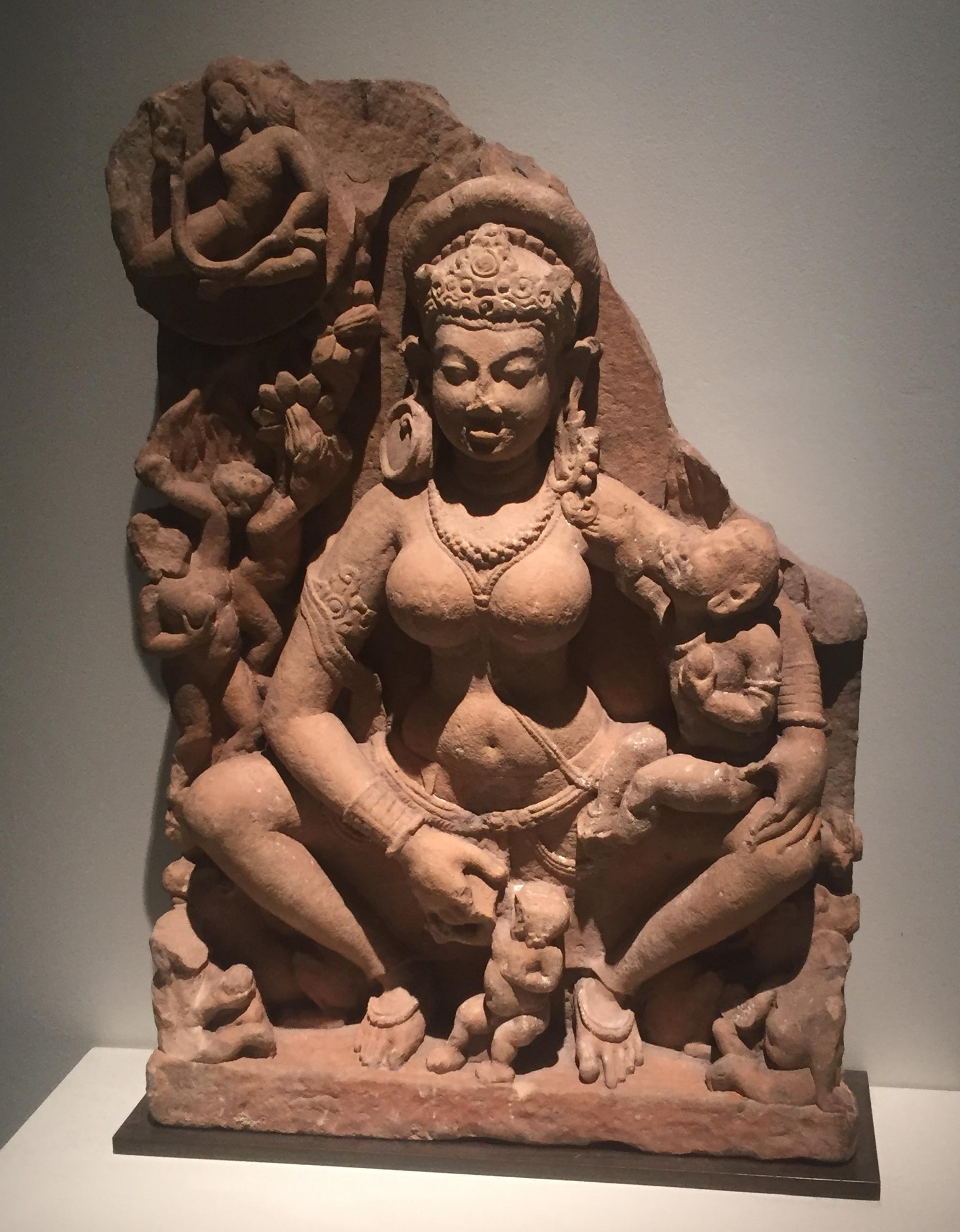
Mother Goddess
The notable part of Indian culture is Hinduism and Buddhism, so, no wonder, many of sculptures represent the gods:
Vishnu, one of three major gods in Hinduism; God of Protection, Preservation of Good, Controller of entire Universe, Karma restoration, Moksha (various forms of emancipation, enlightenment, liberation, and release)
Parvati, or Mother Goddess, the Hindu goddess of fertility, love, beauty, marriage, children, and devotion; as well as of divine strength and power.
Bodhisattva, in Buddhism, any person who is on the path towards Buddhahood.
The next part is “Central Asia Gallery”. The items presented here were mostly excavated from Xinjiang, China.
7th-8th century
Fuxi and Nuwa 7th century
6th-7th century
6th-7th century
The exhibited items were mostly excavated from Xinjiang, China, including Astana Cemetery (4th-8th century) near Turpan. The objects of the Astana tombs came to the museum from Japan, during the annexation of 1910, where they had been brought from expeditions of Ōtani Kōzui in 1905.
Fuxi 伏羲 and his sister, Nuwa 女媧, are the mythological creators of mankind. They have snake-like tails and humanlike upper part of the body. The myth of mankind creation varies depending on the source since during the thousands of years numerous Chinese nations retold and developed the myth in their specific way.
The legend fro Tianshui City, Gansu Province. There was only one old woman in ancient times. One day, she saw a big footprint and stepped on it. Unexpectedly, she has got pregnant. The old woman gave birth to a boy and a girl. After the death of the old woman, the children lived by themselves, hunted, grew up. One day it has become the time to discuss a thing of two (man and woman thing). They decided to verify the possibility of their marriage using millstones. They let the millstones rolldown from Wutai mountain. The result was the millstones matched each other, which meant they can marry. After the marriage, mankind was pullulating.
In other variants, Fuxi and Nuwa used fire smoke from two separate sources to verify the marriage; or, used clay to create people.
The next galleries are “China Gallery” and “Sinan Shipwreck Collection Gallery”.
Bodhisattva Song Dynasty
Pensive Bodhisattva Northern Qi
Northern Song
Celadon Pillow Song Dynasty
Southern Song
Late 13th – early 14th century
The last part of the “Asian Arts” is “Japan Gallery”.
1664-1660s
Noh masks 16th-17th century
Story of the 53 station of the TokaidoRoad: Yokkaichi
The other exhibition on the third floor is “Sculpture and Crafts”, consisting of 5 galleries.
“White Porcelain Gallery”. The “proto-porcelain” was invented in Shang dynasty (1600–1046 BC). By the late Sui dynasty (581–618 AD) and early Tang dynasty (618–907 AD), the now-standard requirements of whiteness and translucency had been achieved. By the time of the Ming dynasty (1368–1644 AD), porcelain wares were being exported to Europe.
Korean porcelain was first produced in the late 9th or early 10th century. The early period of the production of the white porcelain begins in 1467-1468 when royal ware was first produced at the kilns in Gwangju (a place I am going to visit later). The white porcelain is the representative pottery of the Joseon Dynasty (1392–1897) in Korea.
Seoul, 15th-16th century
15th century
“Buncheong Ware Gallery”. Buncheong ware (粉靑沙器) originated as low quality inlaid celadon produced in the late Goryeo Dynasty, but in the early Joseon Dynasty, it evolved into an entirely new type of pottery with unique aesthetic features. Buncheong ware is made by coating the surface of celadon with white mud. There are seven major methods to create the patterns (inlaying, stamping, incising, reverse inlaying or sgraffito, painting, brushing, dipping).
Stamped design and inscription 15th century
Sgraffito 15th-16th century
Incised design 15th-16th century
Sgraffito design 15th century
“Celadon Gallery”. Celadon is a type of green glaze or a ware glazed with celadon. Under the influence of China’s Yue ware, in the 9th-10th century, along with white porcelain, Koreans began producing celadon too. Later, the war with the Yuan Dynasty (1271–1368) and the Japanese invasions (late 14th century) indirectly caused the gradual decreasing of the celadon quality, which ended up with the emerge of the Buncheong ware.
Vajra is is a weapon used as a ritual object to symbolize both the properties of a diamond (indestructibility) and a thunderbolt (irresistible force). It is used symbolically by the dharma traditions of Buddhism, Jainism and Hinduism.
“Buddhist Sculpture Gallery”. When travelling around South Korea I have seen many Buddhist temples, so, it is obvious that Buddhism played an important role for hundreds of years in the history of Korea, no surprise there is a special section dedicated to Buddhist sculptures. Since the museum also is an educational centre, I discovered here quite interesting information about the appearance of Buddha in different countries and types of Buddha’s poses.
Pensive bodhisattva
Golden Buddha and Amitabha Buddha
The oldest Buddhist sculpture with an inscribed date that has ever been found in Korea, circa 539 CE.
Bhaisajyaguru Buddha
Avalokiteshvara Bodhisattva
Avalokitesvara Bodhisattva
A bodhisattva is a being who is dedicated to achieving complete Buddhahood (the condition or rank of a buddha “awakened one”). There are different classifications of the bodhisattva, containing from a couple up to hundreds of bodhisattva. However, 8 primary bodhistavas are distinguished, among them, Avalokiteśvara, a bodhisattva who embodies the compassion of all Buddhas. Previously I have seen Avalokiteśvara in Geumdangsa temple, Maisan.
Bhaiṣajyaguru – the Buddha of healing and medicine.
Amitābha – a celestial buddha.
Goryeo period 10th century
Goryeo period 10th century
Unified Silla 8th-9th century
Goryeo period 10th century
Goryeo dynasty 11th century
Views around the museum.
That is all about the National Museum of Korea. I strongly recommend to visit it because the museum exhibits a great collection of the artefacts covering various topics, it provides rich information about the history and the culture, and, moreover, the entrance is free of charge.
And, of course, such an inspiring visiting should be followed by a delicious supper!
During this trip I have visited Gangneung, Pyeongchang, Jeongseon and Taebaek in Gangwon province. The next destination also is in Gangwon – it is Gossigul cave in Yeongwol country.
Gossigul 高氏窟 is a limestone cave formed 400 million years ago, it is 6.3 km long. The cave is one of the longest in South Korea.
The ranking of the most notable in South Korea natural objects, e.i., mountains, islands, waterfalls, caves, is top-secret information, so, sometimes it is a great challenge, often, fruitless, to find the information about the objects. Thus, previously I thought that Ojang waterfall is the longest in South Korea, however, later I found that there is a longer waterfall, Towangseong waterfall, consisting of 3 steps with the total length of about 320 m. When talking about caves, I can mention only some of the notable caves, among them, Manjanggul lava tube (8.9 or 13.3 km) on Jeju island, and Hwanseon cave (6.2 or 8 km) near Samcheok, Gangwon province, which should be the longest limestone cave in South Korea. By the way, the longest cave in Ukraine is Optymistychna (optimistic) cave, with the total length of the mapped passageways of about 240 km, making it the 5th longest cave in the world and the longest gypsum cave in the world.
Near the entrance to the cave. A part of the Han river connecting 4 rivers, Seogyocheon, Sogang, Pyeongchang, and Jucheongang. During the Japanese invasions of Korea (1592-1598), the cave has become a shelter for the Go 高 family 氏, since then the cave was called as the cave of Go family, Gossigul, 高氏窟.
The art of nature, diverse in shapes and colours, made during the millions of years.
Some of the formations are weird and reminds creepy creatures, one of the famous here is octopus leg.
Nevertheless, the absence of the descriptions didn’t stop my imagination to see the whole zoo on the cave walls.
By the way, one could really meet living creatures in the cave, and not only people or bats but shrimps too, who supposed to live in ponds like these.
A toilet of the cave people.
Photo zones on the bridge leading to the cave.
That’s all about Gangwon for now. It is time to have some food.
Previously I have visited Gangneung, a city in Gangwon province. Today I am going to visit few more places in this province.
The first destination is a country famous around the world as a host country of the Winter Olympics in 2018, Pyeongchang.
I have spent a night here after visiting Gangneung, and by the afternoon I left this place, so nothing much was explored.
On the way, I discovered one quite attractive spot. It is Baekseok waterfall 白石瀑布. It is located it Najeon-ri, Bukpyeong-myeon, Jeongseon country.
A funny thing about the waterfall is that from this observation point water seems to fall from the highest point of the mountain like it is erupting from a volcano. To my best knowledge, the tallest waterfall of South Korea is Ojang waterfall 五臧瀑布 (127 m), also located in Jeongseon country. So, Baekseok is one of the tallest waterfalls in South Korea.
Jeongseon country 旌善郡 appears in history as Ingpaehyeon 仍貝縣 during Goguryeo Dynasty ( 37 BCE–668 CE ) and gets the present days name in 1012. The character jeong 旌 means aflag or to honour; the character seon 善 have many positive meanings and can be translated into English as good, beautiful, good, kind, excellent, best; kindhearted, hospitable, friendly; auspicious, happy. Then, Jeongseon may mean to honour goodness. By the way, the name of the tallest waterfall, Ojang 五臧瀑布, contains character jang 臧 which also can be a synonym for seon 善, however, oajng 五臧, as 五藏, usually is referred to five classic books of Buddhism or five organs of a man (heart, liver, spleen, lung, kidney).
The next destination in Jeongseon is Jeongamsa Jeogmyeolbogung temple 淨岩寺 寂滅寶宮.
The exact date when the temple was built is unknown, but, it is believed that it was built by Silla queen Seondeok (died in 647), who is the first reigning queen in the history of Korea. Jeogmyeolbogung 寂滅寶宮, nirvana precious palace, is a type of temples built during Silla to enshrine Shakyamuni Buddha, the founder of Buddhism. A specific feature of this kind of temples is that there are no Buddha statues because there are remains of the Buddha’s body (사리, 舍利, śarīra). Here, the sarira is stored in the Sumano Pagoda 水瑪瑙塔.
The pagoda is made up of gray-green limestone bricks, due to this, it has got name Sumano 水瑪瑙 – watery agate.
Another specific feature of the temple is wind bells, punggyeong 風磬, with fishes hanging on bell-clappers.
And the river rapidly flowing down makes beautiful scenery.
It is time to move on!
From Jeongseon country we entered to Taebaek city. Here the plan was to visit Hambaeksan mountain, but, for some reason, the way was locked. So, I just had a chance to look around on the roadside.
Being not far from the border between Jeongseon and Taebaek, after a short time we entered Jeongseon again, and found an unplanned attraction here!
Manhangjae forest park. It is a perfect place to enjoy the variety of mountain plants and insects accompanying them. Many people are resting there, having picknics; there’re many nice paths to walk around, photo exhibition, and information stands about the local plants. There diversity of the plant species must be really great because I didn’t see many of the plants shown on the stands, maybe it is not the time for those species.
It is not yet all about Gangwon province, but it is time to move on!
Gangneung is a city on the east coast of South Korea bordering the East Sea.
As long as I am in South Korea, the sea is called the East Sea, if I would be in North Korea, the sea would be called the East Sea of Korea, and if I am somewhere else around the world, it would be the Sea of Japan. A dispute is going on about the sea’s name.
The population of 213,199 people is quite bigger than that of some countries I visited before, Jinan (24,00), Buyoe (95,213), nevertheless, it is just 46th biggest city in South Korea.
Gangneung was the place where Yemaek people lived from ancient times (an ancient tribal group who are regarded as the ancestors of modern Koreans). First records about the city appears in 129 BC, when it was a part of Wiman Joseon (Gojoseon kingdom), the next year, 128 BC, it became a territory of the Han Dynasty. So, this city exists at least for 2148 years.
The city had many names, and only in 1263, it was renamed to Gangneungdo 강릉도 江陵道. It is that case then the letter ㄹ is pronounced as n but not l or r. The name of the city could be translated as river hill. By the way, the place I visited before, Ganghwa, contain the same word gang 江.
That day, the weather was rainy and on the way, everything around was flooded with impenetrable fog. But once we passed over that magic river hill, the weather surprised with the clear blue sky!
Amazing feeling and amazing photos. As I mentioned in my previous story, I like the East Sea more than the Yellow Sea. Same as the dispute, the waves rage on the sea, the sun plays along with them making up the dramatic scene.
The other stop I have visited in Gangneung is Gyeongpodae Pavilion, 鏡浦臺, Mirror Shore Tower.
The pavilion was built in 1326 at the site of Inwolsa temple, and in 1508 it was moved to the present day’s location. The pavilion opens a panoramic view of the mountains, the lake, the sea and the pine grove by the beach.
Nearby the pavilion, there is a Memorial Tower dedicated to the soldiers and policeman who died during the Korean War.
The museum is located in Seoul, Seodaemun district. One of the reasons to visit this museum is my interest in nature, and even though the museum was located quite far away from my apartment, I decided to do it.
It was an adventure for me to find the museum. Innocently, I just followed a route proposed by an app. I had to take a subway and then to walk about 2 km to the museum. It took a long for me because any time you walk in a new area time goes slower. I went away from a noisy highway, and came to a quiet narrow street, here the app showed the final destination. But what is there? Just a private living house. I looked around, there is nothing like a big museum. The problem was that the address of the museum is quite long, so the app decided to cut the long address and led me to a point far away from the museum. The sun is burning, and I am too old for such long-distance walks, but I had to walk for about 2 more km. In addition to this, a stranger in a shop scared me, he was cursing in English loudly while talking to me and I didn’t get a word; I thought that this area is quite unusual. All the struggles worth what is awaiting me in the museum!
As I noticed, in South Korea, not only some kind of fun museums but even boring one (dedicated to very specific and complicated topics) are aimed to attract the very young audience by numerous interactive spots, one can click buttons or touch a copy of an ancient vase. Didn’t you ever want to touch some item or turn it around to have a better look on it? This museum is educational like, so the majority of the visitors are children and their parents. I am a child too since I never visited such a big museum of nature.
Everything starts from the very beginning, solar system, the birth of Earth, birth of life on Earth and so on. The website of the museum provides detailed information about the exhibitions in English.
After the orthoceras, trilobites and ammonites the dinosaurs emerge.
The millions of years flew by in a few minutes, and modern animals are here, mammals, birds, fishes, insects, molluscs and so on.
Art of nature, beetles (Chrysochoroa, Chrysina ect).
Sculptures outside the museum. That’s all about the museum, and it is time to find the way back home.
I went to another metro station by a new route through Ansan Urban Nature Park. It is a park where one can feel himself being far away from crazy city life, though the park is situated right in the city centre, so one can see the city while walking on the high paths.
Ganghwado (江華島) is the biggest island of the Ganghwa country (red) which is a part of the Incheon municipality (yellow). Previously I visited some parts of Incheon, including Yeongjongdo and Songdo. With area of 303 sq km, it is the 4th (among 3215) biggest island in South Korea. The population of the island is 65,000 people.
Ganghwado has a rich history, through thousands of years, carrying to us evidence of Korean culture. There are about 150 dolmen, a type of single-chamber megalithic tomb usually consisting of two or more vertical megaliths supporting a large flat horizontal capstone or “table” ( the word dolmen is supposedly derived from a Breton language term meaning stone table).
The landscape here is flat making it exceptional because usually huge mountains showing up from everywhere, but here, the mountains are far away and hidden in the fog, making the whole picture like that of Ukrainian forest-steppe. I suppose these are the houses of the people who built dolmen.
Here is a dolmen, and a brain exploding theory about how could it be possible. The stones are really huge, but maybe these are light? Maybe, kimchi gives you power!
I am not sure about kimchi, but there are few plants associating exclusively with the island, for example, Ganghwa turnip, or yellow sweet potato. I must come back and try it.
The island is located close to the border to North Korea, the closest distance is 1.8 km. There is an observatory, Peace Observatory of Ganghwa, where one can observe North Korea. This, in general, seems strange to me, spying people like they are animals in a zoo.
The day I went there, the visibility was bad due to fog, so I didn’t see much North Korea.
The third biggest island in Ganghwa country is Seonmodo (43 sq km). The meaning of the islands name 席毛島 remains uncertain for me. I think the character 席 originally meant mat (a tight wicker rug made of straw, reeds, bast, etc.); then, this word became designating some places where the mat was lied, for example, a seat near a table (during dinner or a meeting), a place as a position of an officer, a banquet, a sail. The character 毛 means wool or feather. Then, considering two characters combined, 席毛 might mean mat’s wool. Actually, some “lumps of wool” met me near a convenience store. The cats were lying right on the tables and thinking “Why are you staring at me, I’m just sleeping here”.
One of the main attractions on Seonmodo is Bomunsa Temple 普門寺, located on Nakgasan Mountain 洛迦山 (267 m). The mountain is called after the Mount Potalaka (補陀洛伽山 or 普陀洛迦山), the mythical dwelling of the Avalokitesvara, said to exist in the seas south of India. Avalokitesvara, or Guanyin (Chinese tradition), is Buddhist Bodhisattva associated with compassion; another Avalokitesvara I have seen at Geumdangsa temple, Maisan, Jinan.
According to a legend, the Bomunsa Temple was founded in 635, during Silla. Once, a fisherman threw a net into the sea and caught 22 man-shaped rocks at once. The man was disappointed by the catch, he just threw the rocks into the sea. Then the man threw the net again, and the same rocks were caught, the man threw them into the sea again. After that, the man just went back home. That night, an old monk appeared in the man’s dream and said, that the rocks he caught are pieces of precious Buddha statue sent from the Kingdom of Heaven. The monk rebuked the fisherman that he threw the rocks in the sea, and begged him to bring the rocks to the sacred mountain tomorrow. The next day, the man picked up and moved the 22 (23) rocks to Nakgasan Mountain, as the old monk begged in the dream. When the man reached the Bomunsa Cave, the rocks suddenly became heavy and he could not move them anymore. Thus, the man thought that this is a spiritual place to enshrine Buddha.
Wabuljeon (臥佛殿), reclining Buddha, is an image that represents Buddha lying down. It represents the historical Buddha during his last illness, about to enter the parinirvana. The construction of this statue had begun in 1980 and was completed in 2009, the statue is 13.5 m in length and 2 m in height***.
The next destination is Ganghwa Jeonghab Resort, land luge track. Winding tracks lie on the hillside of the Gilsangsan mountain. Once you go up by a cable car, you can choose a track with different difficulty level to go down on a car. I am not used to the extreme, so, I was sliding down quite slowly comparing to other drivers who almost flew past me. I have tried two tracks and it was an exciting experience!
The next destination is Jeondeungsa (傳燈寺) temple. Jeondeng 傳燈 literally means to pass a lantern, which can be interpreted as to pass on the light of Buddha, or to pass the doctrinal torch from master to disciple. The temple proves the accordance of this name by an offer of Templestay programs for visitors to experience Buddhist culture. Even I got a chance to feel the culture, I was kindly invited to join a group of visitors to ring a bell during the evening mass.
It is believed that the temple was founded in 381, by a Buddist monk Ado (阿道) from Eastern Jin, who introduced Buddhism to Goguryeo. If it is true, then Jeondeungsa temple is the oldest temple in Korean Penisula.
Nearby the window of the temple, there is a poem written by a Chinese poet, musician, painter, and politician during the Tang dynasty, Wang Wei (王維, 699–759). It is hard for me to define the form of the calligraphy, because it differs from the small seal script (220 BC), at the same time, some of the characters have calligraphy similar to the calligraphy of Han Dynasty 漢隸, “無極山碑” (202 BC ~ 220 AD) and other are similar to the calligraphy of Qin State 秦系简牍文字 (897-206 BC). And again, just same as in the case with Deng Shiru 鄧石如 poem written in small seal script, the calligraphy style is much older than the common one used during the poet life (regular scrip). Nevertheless, with the help of the Internet, the characters were defined:
山河天眼裡 世界法身中
the homeland (mountains and rivers) in heaven’s gaze (heavenly eye), the world in Dharmakaya (one of the three bodies of Buddha).
One notable feature about the temple is a number of quite old trees. Some of them are 300, 400 or even 700 years old. Many generations of people were taking care of the trees to let us to feel the power of nature and reflect on fleeting human life.




 lezhok